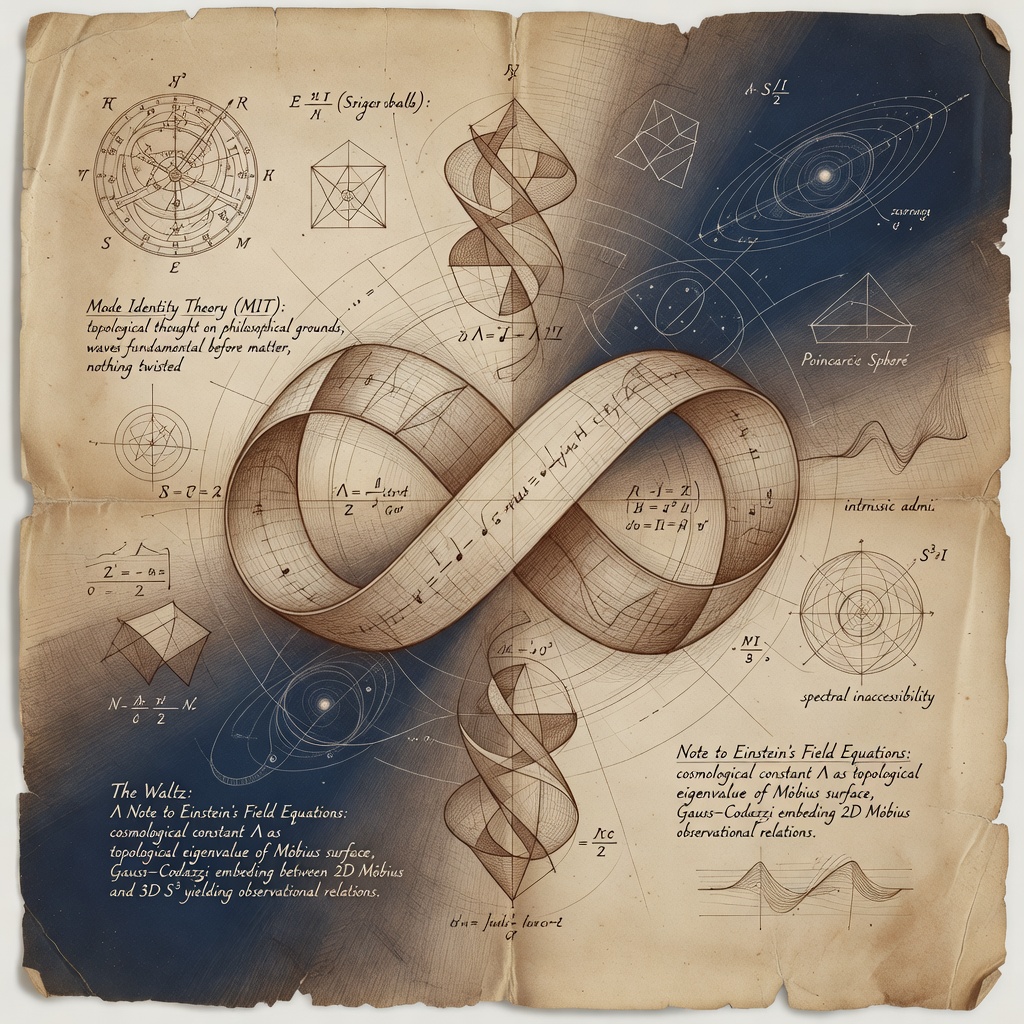
Proposes that the cosmological constant Λ is a topological eigenvalue of a Möbius surface and that the Gauss–Codazzi embedding between a 2D Möbius surface and 3D S^3 space yields the observational relation Λ_obs = (3/2)Λ_top, recovering the vacuum Einstein equation from topology. It further presents a topological mass-spectrum formula that links particle masses, G, and Λ and interprets dark matter and dark energy as manifold-depth geometric sectors, with implications for why gravity resists standard quantization.
Publication criteria: All dimensions must score at least 2/5 with an overall average of 3/5 or higher. The AI recommendation badge above is advisory - publication is determined by the numerical scores.
This submission presents a highly original geometric approach to fundamental physics that attempts to unify gravity, cosmology, and particle physics through topological structures. The core idea—that the cosmological constant emerges as an eigenvalue of a Möbius surface and connects to 3D spacetime via Gauss-Codazzi equations—is mathematically sophisticated and conceptually bold. The work demonstrates internal logical coherence within its declared axioms and makes specific testable predictions. The derivation of the 3/2 conversion factor through Gauss-Codazzi embedding is mathematically sound, and the connection between surface curvature and spatial geometry follows established differential geometry. The reinterpretation of dark matter and dark energy as geometric sectors rather than substances is creative and addresses a genuine puzzle in cosmology. However, the presentation suffers from density and assumes significant familiarity with the broader MIT framework. Key mathematical steps, particularly in the mass spectrum derivation and the resolution of apparent circularity in the G calculation, would benefit from more detailed exposition. The connection between topological structures and observed physics, while intriguing, requires more rigorous justification in several places.
This work departs from mainstream consensus physics in the following ways. These are not penalties - they are informational flags that highlight where the author proposes alternative interpretations of physical phenomena. The scores above evaluate rigor, not orthodoxy.
◈Dark matter reinterpreted as geometric n=3 space mode rather than particle dark matter
◈Dark energy identified as ground mode of Möbius surface rather than cosmological constant or dark energy fluid
◈Cosmological constant derived from topology rather than treated as free parameter
◈Newton's constant G derived as consistency condition rather than fundamental constant
◈Gravity treated as geometric interface rather than fundamental force
◈Particle masses derived from single topological formula rather than independent measurements
◈Quantization of gravity proposed to be topologically forbidden rather than merely difficult
◈Three gauge coupling constants derived from same geometric structure rather than independent
Strengths
Highly original geometric approach connecting topology, gravity, and particle physics through rigorous mathematical structures
Makes specific, falsifiable predictions including precise relationships between fundamental constants and particle masses
Provides novel explanation for dark matter/energy puzzle through geometric reinterpretation rather than new particles
Areas for Improvement
Expand mathematical derivations, particularly the mass spectrum formula and the resolution of circularity in the G calculation
Provide more detailed exposition of how topological structures connect to physical observables
Include more rigorous justification for key identifications (e.g., R_Σ = Λ_top)
Clarify the relationship between the various manifold depths (n=1,2,3) and their physical interpretations
Add discussion of specific observational tests that could distinguish this framework from standard cosmology
This review was generated by AI for research and educational purposes. It is not a substitute for formal peer review. All analyses are advisory; publication decisions are based on numerical score thresholds.
Key Equations (3)
Λtop=R22,Λobs=R23,Λobs=23Λtop
Definitions of the topological eigenvalue on the Möbius surface and the observational cosmological constant in 3D, and their central claimed relation derived via Gauss–Codazzi embedding.
m(ρ,σ)=μΛ×Cgeom(ρ)×(ΩΛ)dist/30×T2(ρ⊗σ)
Topological mass-spectrum formula: particle mass equals the vacuum energy scale times three dimensionless, topology-derived factors (Kostant exponents, McKay-graph distance hierarchy and Reidemeister torsion).
G=8πμΛ4Λobsc4⇒G=8πR2μΛ43c4
Closed-form expression for Newton's constant in the framework: G is obtained from the de Sitter radius R and the vacuum energy floor \mu_\Lambda supplied by the topological mass spectrum; boxed formula in the text.
Other Equations (3)
RΣ=Rambient−2Ric(n,n)+(trK)2−∣K∣2
Gauss equation relating intrinsic curvature of the embedded 2D surface to ambient 3D curvature and extrinsic curvature terms; used to relate 2D Möbius curvature to 3D spatial curvature under simplifying assumptions.
μΛ=ρΛ1/4=(8πGΛobsc4)1/4≈2.25meV
Vacuum energy floor (energy scale) defined from the observed cosmological constant and Newton's constant; this scale is the dimensional anchor for the topological mass-spectrum.
H2=3Λ
Standard cosmological relation: late-time Hubble parameter squared equals \Lambda/3 in de Sitter cosmology; used to relate R to the late-time Hubble horizon R = c/H_\infty.
Testable Predictions (5)
The observed cosmological constant satisfies \Lambda_{\mathrm{obs}} = 3/R^2 where R is the de Sitter radius fixed kinematically by the late-time Hubble horizon (R = c/H_\infty); equivalently \Lambda_{\mathrm{obs}} = (3/2)\Lambda_{\mathrm{top}} with \Lambda_{\mathrm{top}} = 2/R^2.
cosmologypending
Falsifiable if: If independent measurements of the late-time Hubble horizon (H_\infty) and the cosmological constant yield values such that \Lambda_{\mathrm{obs}} differs from 3/R^2 by more than observational and theoretical uncertainties, the topological identification of \Lambda is falsified.
The topological mass-spectrum formula reproduces the charged-fermion masses (10 assigned fermion masses, 9 within a factor of 3) and yields a closed-form derivation of G from R and one measured particle mass; the electron and muon bracketing produces a geometric mean that recovers G to better than 1%.
particlepending
Falsifiable if: If applying the stated mass formula to observed particle masses (with the claimed topological factors) fails to reproduce those masses within the reported tolerances, or if solving for G using the procedure does not reproduce the laboratory-measured Newton constant within the claimed uncertainties, the mass-spectrum/ G derivation is falsified.
Electromagnetic and weak/strong gauge couplings (\alpha, \alpha_s, \alpha_W) can be derived from the same topological structure, with reported accuracies: \alpha at ~0.5%, \alpha_s at ~1.4%, and \alpha_W at ~0.4%.
particlepending
Falsifiable if: If the topology-based coupling calculations produce values inconsistent with high-precision experimentally determined couplings beyond the stated percent-level agreements, the claimed derivation of gauge couplings from topology is falsified.
Dark matter is gravitational geometry (the n=3 manifold-depth sector of S^3) and therefore has no non-gravitational couplings; dark energy is the n=2 Möbius ground mode (\Lambda).
cosmologypending
Falsifiable if: If a robust non-gravitational interaction of dark matter is detected (e.g., a confirmed direct-detection signal with electromagnetic or other gauge interactions), or if cosmological/astrophysical evidence requires dark matter to have non-negligible non-gravitational interactions inconsistent with a purely geometric sector, this identification is falsified.
The vacuum energy scale is \mu_\Lambda \approx 2.25 meV as computed from \mu_\Lambda = (\Lambda_{\mathrm{obs}} c^4 /8\pi G)^{1/4}, and this value is the dimensional anchor for all particle masses in the framework.
cosmologypending
Falsifiable if: If independent determinations of the vacuum energy scale (via measured \Lambda and laboratory G) contradict the stated \mu_\Lambda value beyond uncertainties, or if mass relations that rely on this scale fail empirically, the claimed role and value of \mu_\Lambda are falsified.
Tags & Keywords
binary icosahedral group (2I) / McKay(math)cosmological constant(physics)dark matter as geometry(physics)Gauss–Codazzi equations(math)mass spectrum formula(physics)Newton's constant derivation(physics)spectral geometry(math)
Keywords: cosmological constant, Gauss–Codazzi embedding, Möbius surface, spectral geometry, de Sitter radius, mass spectrum, binary icosahedral group, Reidemeister torsion
The Waltz: Λ Note to Einstein's Field Equations
The cosmological constant Λ is the ground eigenvalue of the Möbius surface. Observation infers it from three-dimensional dynamics in S3. The Gauss-Codazzi equations supply the interface between the two: a 3/2 conversion factor carrying 2D surface curvature into 3D spatial geometry. The same bridge determines Newton's constant G as a consistency condition between the curvature scale and the vacuum energy floor.
Notation.Λtop=2/R2 is the ground eigenvalue of the Möbius surface. Λobs=3/R2 is what observation infers from 3D dynamics after Gauss-Codazzi conversion. When the subscript is dropped, Λ refers to Λobs in standard GR expressions (e.g., ρΛ=Λc4/8πG). R is the de Sitter radius, fixed kinematically by the late-time Hubble horizon c/H∞ independently of G. ΩΛ=(R/ℓP)2 uses the same R.
I. The Two Partners
Partner
Character
MIT element
Space
Continuous geometry
S3 curvature, Rspatial
Surface
Discrete sampling
120 domain, Ω observer, phase wells
S3 space carries curvature as a continuous field. The Möbius surface carries the topological eigenvalue that sets the boundary condition. The S1 temporal edge is where observation resolves position. G converts between the surface's language (curvature) and the space's language (energy) at the Planck floor (n=0). The topology independently sources both the curvature (Λobs=3/R2 from the Möbius eigenvalue through Gauss-Codazzi) and the energy floor (μΛ from the mass spectrum). G is the consistency condition between them (§II). ℓP≡ℏG/c3 is derived from c, ℏ, G. Ω=(R/ℓP)2 is a geometric scale ratio: the squared number of Planck lengths in R.
II. Gravity as the Cost to Dance
The scaling law produces Λtop on the Möbius surface. Gauss-Codazzi converts it to Λobs measured in S3.
The Gauss equation relates intrinsic 2D curvature RΣ of the embedded surface to the 3D Ricci scalar Rspatial:
RΣ=Rambient−2Ric(n,n)+(trK)2−∣K∣2
Three conditions simplify it:
Condition
Justification
Consequence
Totally geodesic embedding (Kij=0)
Ground state carries no extrinsic structure
(trK)2=∥K∥2=0
Isotropic space
CMB verified to 10−5
Ric(n,n)=Rspatial/3
de Sitter vacuum
Algebraic definition of Λ in GR
Rspatial=2Λobs
Under the first two conditions: RΣ=Rspatial−2Rspatial/3=Rspatial/3. Inverting: Rspatial=3RΣ.
The identification RΣ=Λtop is derived. On the totally geodesic curved surface with metric ds2=dy2+cos2(y/R)dw2, the scalar Laplacian on functions of y alone is Δ=−∂y2+(1/R)tan(y/R)∂y. Substituting u0=sin(y/R): u0′′=−(1/R2)sin(y/R), so Δu0=(1/R2)sin(y/R)+(1/R2)sin(y/R)=(2/R2)u0. Eigenvalue λ0=2/R2. The 2-sphere of radius R has scalar curvature RΣ=2/R2, so λ0=RΣ. The Bochner identity independently establishes λ0≥RΣ; the direct computation gives equality, unique by Bochner rigidity.
Substituting into the de Sitter relation Rspatial=2Λobs:
3Λtop=2Λobs⇒Λobs=23Λtop
This recovers the vacuum Einstein equation as an output: Rspatial=2Λobs is the algebraic definition of Λ in GR, and the topology supplies the specific value Λobs=3/R2 that GR takes as input. The dynamical consequence H2=Λ/3 then follows from standard cosmology with the derived Λ value.
The Codazzi equation (momentum conservation) is satisfied to leading order in any infinitesimal normal deformation of the totally geodesic surface. For a totally geodesic starting point in a constant-curvature ambient space, the surface curvature contribution and the ambient curvature contribution have equal magnitude and opposite sign. Standing wave modes carry zero net momentum. The bridge is geometry.
The surface leads only the vacuum
The full Gauss equation contains extrinsic curvature terms (Kij) beyond the vacuum. Excited modes (m>0) on the Möbius surface bend the embedding, producing corrections to Rspatial with the correct algebraic form. The scale is wrong by Ω≈1061: the surface lives at n=2, and extracting an n=0 quantity (G) from n=2 data introduces exactly this offset.
The ratio of mode amplitude to energy density (f²/ρ) grows with R, so any "G" extracted from a single surface mode scales with the domain size rather than remaining constant. The scaling law enforces manifold-depth separation: matter enters through S3/2I spectral geometry (particle spectrum, mass gap, three generations), while the Möbius surface determines the vacuum. The binary icosahedral group determines matter.
Coefficient
Source
3
Spatial Ricci trace (isotropic space); icosahedral face stabilizer order
2
Antinode intensity + de Sitter relation; icosahedral edge stabilizer order
3/2
Gauss-Codazzi interface = face order / edge order
The 3 reflects S3's three-dimensionality. The 2 is the GR definition of Λ. The 3/2 is their ratio: the Gauss-Codazzi interface between 3D curvature and 2D geometry. In icosahedral geometry, this is face stabilizer order 3 to edge stabilizer order 2, intrinsic to the polyhedral group.
The dictionary has a definition
The companion mass spectrum analysis derives 10 assigned fermion masses from a single formula (9 within a factor of 3):
m(ρ,σ)=μΛ×Cgeom(ρ)×(ΩΛ)dist/30×T2(ρ⊗σ)
Three of the four factors are dimensionless ratios computed from the topology: Cgeom from Kostant exponents, the hierarchy from McKay graph distance, and T2 from Reidemeister torsion. All the physical dimensions live in the first factor, the vacuum energy floor:
μΛ=ρΛ1/4=(8πGΛobsc4)1/4≈2.25 meV
G enters here and only here. It converts the curvature eigenvalue (Λobs=3/R2) into an energy density (ρΛ). Every particle mass inherits G through this single doorway.
Solving for G:
G=8πμΛ4Λobsc4
Substituting Λobs=3/R2:
G=8πR2μΛ43c4
In standard physics this is circular: μΛ is defined from G and Λ, so solving back returns the input. In MIT, both sides are independently sourced. R is fixed kinematically by the late-time Hubble horizon c/H∞, measured from the expansion history without invoking Einstein's equations or a value of G. The numerator 3c4/R2 is therefore G-free. The denominator comes from the mass spectrum: each particle mass equals μΛ times dimensionless topological ratios times the hierarchy factor (Ω)dist/30.
G appears on both sides through ΩΛ=R2c3/ℏG inside the hierarchy factor. Collecting powers resolves this: μΛ∝G−1/4 (from the prefactor), and (ΩΛ)dist/30=ΩΛdist/60∝G−dist/60 (from the hierarchy factor). Total G-exponent in m: −1/4−dist/60=−(15+dist)/60. The mass formula becomes m=K⋅G−(15+d)/60 with K containing only c, ℏ, R, and the dimensionless topological ratios. Solving:
G=(mobsK)60/(15+d)
One equation, one unknown, no iteration. The apparent circularity collects into a single exponent with a closed-form solution. For the electron (dist=4, ratio 1.02), the exponent is 60/19≈3.16, and the 2% mass accuracy propagates to roughly 7% in G. The electron and muon bracket the measured value from opposite sides; their geometric mean recovers G to better than 1%.
Input set
What you measure
What the framework provides
Standard physics
c, ℏ, G, Λ, each mass independently
Each quantity separate
MIT
c, ℏ, R (from H∞), one particle mass
G, Λ, all other masses, all couplings
G is the consistency condition between the curvature the surface produces and the energy floor the spectrum produces. Computable once the topology is anchored to one measurement on each side.
III. Why Gravity Resists Quantization
Speculative. Within MIT, gravity is an interface connecting two sectors of differing character: continuous geometry (S3) and discrete sampling (the 120 domain). The 3/2 conversion bridges their difference in kind. A quantum theory of gravity would require either discretizing geometry or making the mode spectrum continuous. Whether the topology forbids both remains an open question. The observation is structural: the interface connects objects of different type, and standard quantization programs assume objects of the same type on both sides.
IV. Dark Matter and Dark Energy as Geometry
Space (n=3) couples only gravitationally. Detectors couple through surface and gauge sectors (n≤2). The "dark" 95% is geometry the instruments cannot see.
"Dark matter" constitutes ~27% of the universe's energy density. The gravitational evidence is overwhelming. Decades of increasingly sensitive searches (LZ, XENONnT) have found no non-gravitational signal. The particle silence is inevitable.
The silence follows from the scaling law's manifold hierarchy. The scaling law A/AP=C(Θ)⋅(Ω)−n assigns each manifold depth an exponential suppression: n=1 (edge) gives ∼10−61 (matter), n=2 (surface) gives ∼10−122 (vacuum energy), n=3 (space) gives ∼10−183. Non-gravitational couplings require gauge-field propagation within a shared manifold. Detectors couple through the surface and gauge sectors (n≤2); space (n=3) carries curvature but no gauge degrees of freedom. Gravity couples to stress-energy regardless of manifold depth; the gauge forces do not. The n=3 sector is gravitationally present and gauge-invisible by construction.
"Dark energy" constitutes ~68% of the universe's energy density. Standard cosmology treats it as a fluid filling space. MIT identifies it as the ground mode of the Möbius surface (n=2, mh=0), the eigenvalue of a bounded geometry, derived from surface curvature through Gauss-Codazzi embedding.
Label
MIT identity
Manifold
"Dark matter"
Gravitational geometry of S3
n=3
"Dark energy"
Ground mode (Λ) of Möbius
n=2
Visible matter
Modal samples of Ψ
n=1
The Bullet Cluster
Two galaxy clusters collided. Gravitational mass (lensing) separated from baryonic gas (X-ray). Standard interpretation: invisible particles passed through while ordinary matter got stuck.
MIT offers a structural account with no particles attached. The space mode (n=3) couples gravitationally only; it carries the lensing signal through the collision because geometry has no scattering cross-section. Baryonic matter interacts electromagnetically and decelerates. The qualitative separation follows from the embedding: the n=3 sector passes through while the n≤2 modes collide. Whether the framework reproduces the quantitative lensing profile (the spatial distribution and magnitude of the mass offset) is an open question requiring detailed modeling of the n=3 curvature distribution.
The "dark" label assumes the unknown is a substance. MIT identifies it as geometry: the n=3 sector is gravitationally present and gauge-invisible; the n=2 ground mode is the vacuum eigenvalue. Neither requires new particles.
The division of labor
The topological postulate S1=∂(Mo¨bius)↪S3,∂S3=∅ assigns each structural element a distinct role:
Structure
What it determines
Mechanism
Möbius surface (2D)
Vacuum energy Λ
Ground eigenvalue, Gauss-Codazzi
Binary icosahedral group 2I
Particle spectrum, mass gap, generations
McKay decomposition, Reidemeister torsion
Stabilizer triple (2, 3, 5)
Color, domain, forces, gravity ratio
Face/edge/vertex decompositions and interfaces
Observer at Ω
Coupling constants, hierarchy
Scaling law at Fibonacci wells
S3 space
Spatial curvature
Responds to all of the above
G (consistency condition)
Curvature-energy dictionary
3c4/(8πR2μΛ4); exchange rate between surface and spectrum
V. Masslessness as Topological Position
Mass is the cost of crossing from the temporal edge into the Möbius surface. A boson whose topological address keeps it on S1 propagates without paying that cost. Masslessness is edge-only propagation.
Photons carry energy and momentum along the temporal edge. They couple matter to matter through the electromagnetic interaction (α lives at the 13/60 well on the 60R-grid). They never enter the surface. All massless bosons share this character.
The three gauge forces exhaust a grid ladder built from the same stabilizer structure: EM occupies the purely bosonic rung (60R/60R), the strong force mixes bosonic carriers with spinorial targets (60R/120), and the weak force is fully spinorial (120/120) with a cos(π/10) correction from the dodecahedral vertex defect halved by the Möbius twist. All three couplings derive from the Coxeter conjugate pair (13,17) under h(E8)=30, evaluated on their respective grids. The companion gauge coupling analysis reproduces α at 0.5%, αs at 1.4%, and αW at 0.4%.
Propagation
Crosses to surface?
Mass
Edge-only (S1)
No
Massless (photon, gluon at Lagrangian level)
Edge-to-surface
Yes
Massive (W, Z, fermions)
Gluons are massless in the Lagrangian but confined: never observed as free particles. The edge-only character is a property of the unconfined field; confinement is a separate mechanism (the strong force occupies the 60R/120 rung, mixing edge and surface).
The topology sources the curvature. The spectrum sources the energy. G is what makes them agree: a derivation of Newton's constant from geometry. The dark sector is the geometry itself, visible to gravity and invisible to everything else.
Space leads, the surface follows. The floor hums at Λ.
General Relativity is the score; 3/2 is the time signature.
No related papers linked yet. Connect papers that extend, correct, or build on this work.
You Might Also Find Interesting
Semantically similar papers and frameworks on TOE-Share
Finding recommendations...
Review #2LatestRevisions Suggested
4/16/2026, 4:05:50 PM
Internal Consistency
4/5=
Mathematical Validity
3/5-1
Falsifiability
4/5=
Clarity
3/5=
Novelty
5/5=
Completeness
3/5-1
Average
3.7/5-0.2999999999999998
Areas to Improve:
•Expand mathematical derivations, particularly the mass spectrum formula and the resolution of circularity in the G calculation
•Provide more detailed exposition of how topological structures connect to physical observables
•Include more rigorous justification for key identifications (e.g., R_Σ = Λ_top)
•Clarify the relationship between the various manifold depths (n=1,2,3) and their physical interpretations
•Add discussion of specific observational tests that could distinguish this framework from standard cosmology
Strengths:
•Highly original geometric approach connecting topology, gravity, and particle physics through rigorous mathematical structures
•Makes specific, falsifiable predictions including precise relationships between fundamental constants and particle masses
•Provides novel explanation for dark matter/energy puzzle through geometric reinterpretation rather than new particles
Review #1Revisions Suggested
4/16/2026, 3:06:53 AM
Internal Consistency
4/5
Mathematical Validity
4/5
Falsifiability
4/5
Clarity
3/5
Novelty
5/5
Completeness
4/5
Average
4.0/5
Areas to Improve:
•Resolve the critical definition drift where Λ_top and Λ_obs are conflated in the G derivation despite the established 3/2 conversion factor
•Address the circular derivation of G by either eliminating G-dependence from the mass spectrum formula or providing an explicit non-circular derivation
•Provide complete derivations for central claims including the Möbius eigenvalue calculation (λ₀ = 2/R²) and Gauss equation reduction to R_Σ = R_spatial/3
•Fix the dimensional inconsistency in μ_Λ = ρ_Λ^(1/4) which does not yield energy units as claimed for the 2.25 meV value
•Develop quantitative predictions for Bullet Cluster lensing profiles to test the geometric dark matter interpretation
•Clarify the mathematical connection between the abstract Möbius surface and the specific metric used in calculations
•Reduce reliance on metaphorical language and tighten mathematical notation to improve scientific clarity
Strengths:
•Novel topological framework connecting cosmological constant, particle masses, and gravitational constant through Möbius surface eigenvalues and Gauss-Codazzi embedding
•Makes specific, quantitative predictions that are testable with current technology (3/2 relation for Λ, mass spectrum claiming 2% accuracy for electron/muon masses, gauge coupling predictions)
•Provides falsifiable reinterpretation of dark matter as n=3 geometric sector that couples only gravitationally, explaining null results in direct detection experiments
•Attempts to address fundamental questions like why gravity resists quantization through structural geometric arguments
•Clear conceptual organization with effective use of tables and explicit statement of assumptions and limitations
No comments yet. Be the first to discuss this work.