Papers

Research that supports, extends, or challenges theoretical frameworks.

Sign In to Submit

16 papers

PATWΛ

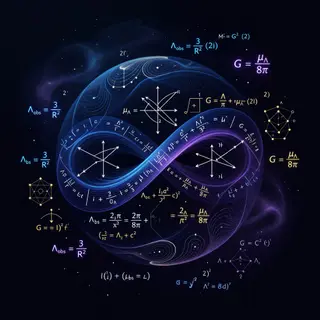
The Waltz: Λ Note to Einstein's Field Equations

The Waltz: Λ Note to Einstein's Field Equations

The paper derives Newton's constant G from topology by identifying the cosmological constant Λ as the ground eigenvalue of a Möbius surface embedded in S^3; Gauss–Codazzi converts this 2D eigenvalue to Λ_obs = 3/R^2 and, together with a topology-derived fermion mass spectrum that fixes the energy scale μ_Λ, yields G = 3 c^4/(8π R^2 μ_Λ^4), reportedly matched to observations at the percent level. It further reframes dark matter and dark energy as geometric sectors at different manifold depths, removing the need for additional particle content.

by Blake L ShattoPublished 4/17/2026Linked to: Mode Identity Theory
A
4.3/5
PASIO

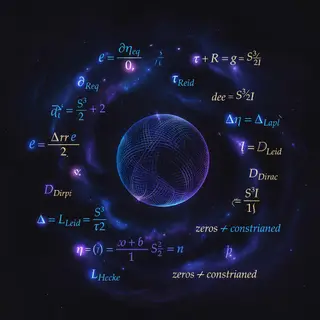
Spectral Inaccessibility on the Poincaré Homology Sphere

Spectral Inaccessibility on the Poincaré Homology Sphere

For the Poincaré homology sphere S^3/2I, every intrinsic admissible spectral construction (from natural Laplacians, Dirac/signature operators, torsion, equivariant eta, and their finite algebraic combinations) can read Dirichlet and Hecke L-function data but cannot constrain zeros of any individual L-function. Any vanishing of such a construction is explained by one of four exhaustive obstructions — shifted-value coincidence, encoding degeneracy, framework mismatch, or character completeness — rather than by forcing L-function zeros.

by Blake L ShattoPublished 4/16/2026Linked to: Mode Identity Theory
A
4.3/5
PAΑFS

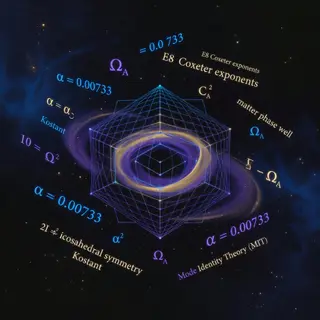
α fine structure: Λ Minimum Step to Mode Identity

α fine structure: Λ Minimum Step to Mode Identity

Using Mode Identity Theory, the paper derives the fine-structure constant and the three Standard Model gauge couplings from a single topological postulate: an icosahedral grid and a matter phase well (13/60) together with a fractional Ω_Λ exponent. The formula yields α = 0.00733 (0.5% error) and similarly close predictions for α_s and α_W, with accompanying structural selection and uniqueness scans.

by Blake L ShattoPublished 4/16/2026Linked to: Mode Identity Theory
A
4.3/5
PAFMF

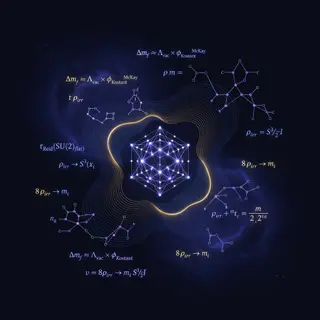
Fermion Mass Formula from Spectral Geometry on S³/2𝐼

Fermion Mass Formula from Spectral Geometry on S³/2𝐼

Constructs a fermion mass formula from spectral geometry on the quotient S³/2𝐼 that multiplies a vacuum-energy scale by a Kostant geometric phase, a McKay-graph hierarchical exponent tied to the cosmological constant, and Reidemeister torsion from three flat SU(2) connections. Applied to 8 irreducible representations across 3 vacua it produces 24 mass predictions, 10 of which are assigned to Standard Model fermions (9 within a factor of 3 and 3 within 6%).

by Blake L ShattoPublished 4/9/2026Linked to: Mode Identity Theory
A
4.3/5
PAOQG

OPERATIONAL QUANTUM GRAVITY FOR ENGINEERS: A revised damping, vacuum-polarizability, and uncertainty-based interpretation of gravitational scaling

OPERATIONAL QUANTUM GRAVITY FOR ENGINEERS: A revised damping, vacuum-polarizability, and uncertainty-based interpretation of gravitational scaling

Proposes an operational engineering description of gravity in which the metric of general relativity is a compact encoding of clock-and-ruler comparisons and is re-expressed via a polarizable-vacuum scalar K, an uncertainty-preserving scaling map, and an effective radiative-damping parameter ζ with K=(1-ζ²)^-1. The paper shows this framework reproduces the weak/static Schwarzschild scaling while preserving Heisenberg products and outlines a coherent, testable experimental program (spectroscopy, clock comparisons, resonance perturbations) without claiming a complete microscopic theory.

by Todd DesiatoPublished 4/9/2026

B+
3.7/5
PAEMY

Easy Money: Yang-Mills on the Poincare Homology Sphere

Easy Money: Yang-Mills on the Poincare Homology Sphere

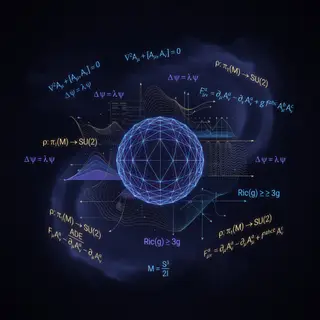
The Millennium Prize asks whether pure Yang–Mills theory on ℝ⁴ has a positive mass gap. On flat space, confinement must emerge dynamically. On the Poincaré homology sphere M = S³/2I, the answer is forced by geometry. Positive Ricci curvature provides a universal floor. The finite fundamental group yields exactly three isolated vacua: trivial, standard, and Galois conjugate. The McKay correspondence for the extended E₈ diagram filters the spectrum at each vacuum, producing a ninefold enhancement at the Galois sector. The same curvature that enters the Λ conversion guarantees confinement.

by Blake L ShattoPublished 4/1/2026Linked to: Mode Identity Theory: Modal Realization from Nested Topology, Mode Identity Theory, Mode Identity Theory, Mode Identity Theory
A
4.3/5
PAMGC

Mechanism-Diagnostic Geometric Constraint on Spin-Fluctuation Superconductors: A Y-Space Analysis of Coherence, Energy Scale, and Fermi Velocity

Mechanism-Diagnostic Geometric Constraint on Spin-Fluctuation Superconductors: A Y-Space Analysis of Coherence, Energy Scale, and Fermi Velocity

Defines a dimensionless diagnostic Y ≡ ln(Tc/θ_glue) − ln(vF*) and, from a curated dataset of 16 superconductors, shows that Y cleanly separates spin-fluctuation (SF) and phonon-mediated (PH) materials (Mann–Whitney p = 0.0005), with SF materials clustering near Y ≈ 0 and PH materials near Y ≈ −3.4. Within SF materials Y exhibits a positive trend with ln(ξ/a), indicating that larger Cooper-pair extent relative to the lattice correlates with higher coupling efficiency, and the finding is robust to θ_glue and vF provenance uncertainties.

by Adam MurphyPublished 3/28/2026
A
4/5
PACAF

CMB Anomalies from Topology

CMB Anomalies from Topology

Three large‑angle CMB features have persisted across COBE, WMAP, and Planck with no explanation within ΛCDM. The Möbius embedding in S³ restricts the mode spectrum at large scales, breaks even‑odd symmetry through the non‑orientable identification, and defines a preferred axis as the twist normal. What has been called the “axis of evil” may be the universe revealing the geometry of its beginning.

by Blake L ShattoPublished 3/23/2026Linked to: Mode Identity Theory, Mode Identity Theory, Mode Identity Theory, Mode Identity Theory
A
4.2/5
PAHLH

H₀ Local: Hubble Tension as Phase Field

H₀ Local: Hubble Tension as Phase Field

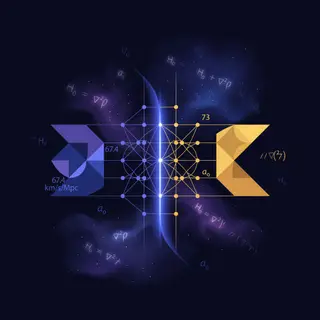
Measurements of the Hubble constant have split into two persistent camps: the cosmic microwave background gives 67.4 km/s/Mpc; local distance ladders give 73. The discrepancy survives every systematic check and every independent method. Mode Identity Theory resolves the tension through the phase field: observers embedded in galactic structure sample from a shifted position on the 120‑domain. The shift is one bosonic step, Θf = 2/120, and the logarithmic slope of the phase operator at the H₀ well converts that step into an 8.4% increase. Both measurements are correct. They sample different positions on the same wave.

by Blake L ShattoPublished 3/22/2026Linked to: Mode Identity Theory: Modal Realization from Nested Topology, Mode Identity Theory, Mode Identity Theory, Mode Identity Theory, Mode Identity Theory
A+
4.5/5
PAAEH

a₀ Evolving: High-Redshift Galaxy Masses

a₀ Evolving: High-Redshift Galaxy Masses

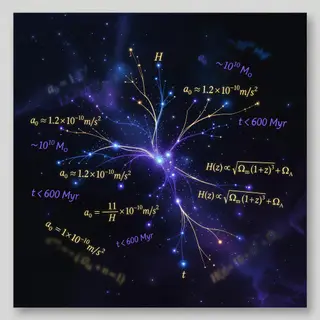
James Webb has found galaxies too massive, too early. Stellar masses of ∼10¹⁰ M⊙ within 600 Myr of the Big Bang require star formation efficiencies exceeding unity under ΛCDM, a physical impossibility. Mode Identity Theory predicts that the MOND acceleration scale a₀ is an edge mode (n = 1) referencing the evolving Hubble horizon: a₀(z) = a₀(0) × H(z)/H₀. At z = 10, this gives a₀ ≈ 20× the local value, enhancing gravitational binding and accelerating structure formation without new physics. Critically, MIT predicts a₀ evolves while Λ remains fixed: the inverse of standard assumptions. Both predictions are independently testable.

by Blake L ShattoPublished 3/22/2026Linked to: Mode Identity Theory: Modal Realization from Nested Topology, Mode Identity Theory, Mode Identity Theory, Mode Identity Theory, Mode Identity Theory
A
4.3/5
PAWEΛ

w Evolving: Λ Topological Resolution

w Evolving: Λ Topological Resolution

DESI reports mounting evidence (2.8–4.2σ) that the dark energy equation of state w evolves with redshift. If true, it would overturn the cosmological constant and reshape modern physics. Mode Identity Theory says the change is an illusion: Λ is fixed by the geometry of the universe, and what looks like evolution is the observer’s phase position on a standing wave. The “phantom crossing” through w = −1 arises as a template artifact rather than exotic physics. Tested against DESI DR2 baryon acoustic oscillation data, the Pantheon+ supernova compilation, and a Planck‑calibrated CMB ruler prior, MIT with locked parameters achieves ΔAIC = −2.1 over ΛCDM at the same parameter count.

by Blake L ShattoPublished 3/22/2026Linked to: Mode Identity Theory: Modal Realization from Nested Topology, Mode Identity Theory, Mode Identity Theory, Mode Identity Theory, Mode Identity Theory
A
4.3/5
PAΛGM

Λ Ground Mode of the Cosmic Boundary

Λ Ground Mode of the Cosmic Boundary

Einstein introduced Λ in 1917 to hold the universe static. When Hubble proved expansion, he removed it, calling it his “biggest blunder.” A century later, standard cosmology revived Λ as dark energy. This note completes the arc: there is no dark energy nor mysterious force. Λ is set by the ground‑mode eigenvalue of the cosmic boundary; the geometry of the universe itself driving expansion. Einstein was right the first time, for reasons then unknown. The Möbius surface selects half‑integer modes; the lowest yields Λtop = 2/R², where R is the curvature radius of S³. The observationally inferred Λobs differs by a factor of 3/2, obtained through Gauss–Codazzi embedding under totally geodesic embedding and isotropy; the surface‑to‑eigenvalue identification is motivated from three directions.

by Blake L ShattoPublished 3/22/2026Linked to: Mode Identity Theory: Modal Realization from Nested Topology, Mode Identity Theory, Mode Identity Theory, Mode Identity Theory, Mode Identity Theory
A+
4.5/5
PAOUP

On Unified Physics and Machine Alignment: Alignment as Ontological Accuracy

On Unified Physics and Machine Alignment: Alignment as Ontological Accuracy

This position paper hypothesizes that entanglement is the primitive of reality and that the structural similarity between physical unification and AI alignment implies many alignment failures are ontological inaccuracies—agents optimizing against a model of separateness rather than a coherently coupled reality. It introduces minimal formal notions (gate-perception, gate-action, ticks) grounded in the double-slit experiment to argue that a unified physical framework would change what counts as rational action and thus materially alter alignment failure modes.

by Adam MurphyPublished 3/21/2026
B
3.3/5
PAQAB

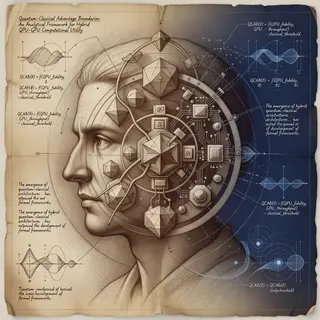
Quantum-Classical Advantage Boundaries: An Analytical Framework for Hybrid QPU-GPU Computational Utility

Quantum-Classical Advantage Boundaries: An Analytical Framework for Hybrid QPU-GPU Computational Utility

This work introduces the Quantum-Classical Advantage Boundary (QCAB) framework, a parameterized analytical model for determining when hybrid QPU-GPU systems outperform classical quantum simulation methods. The framework defines a Quantum Utility Ratio across five physical parameters and establishes scaling laws for the transition to quantum computational dominance.

by Adam MurphyPublished 3/20/2026
A
4.1/5
PARRD

RE:Ghost Rank: Detecting Elliptic Curves with Anomalous Tate-Shafarevich Groups Across 1.9 Million Cremona Curves

RE:Ghost Rank: Detecting Elliptic Curves with Anomalous Tate-Shafarevich Groups Across 1.9 Million Cremona Curves

A large-scale empirical study of the Birch and Swinnerton-Dyer (BSD) conjecture using 1.9 million elliptic curves from Cremona's database, revealing anomalous Tate-Shafarevich groups and establishing a power-law distribution with exponent α ≈ 2. The work provides numerical verification of BSD identities for rank-0 curves and identifies systematic patterns in Sha group sizes across unprecedented dataset scales.

by Adam MurphyPublished 3/11/2026
B+
3.7/5
PADLT

Detecting Large Tate-Shafarevich Groups via BSD Geometric Invariants: Lessons from a Computational Audit of 1.9 Million Elliptic Curves

Detecting Large Tate-Shafarevich Groups via BSD Geometric Invariants: Lessons from a Computational Audit of 1.9 Million Elliptic Curves

We investigate computational methods for identifying elliptic curves with anomalously large Tate-Shafarevich groups ($|Ш| ≫ 1$) among rank-0 curves over $ℚ$. After documenting and correcting circular reasoning in AI-assisted analysis, we find that the BSD geometric factor $α_{BSD}(E) = Ω_E^+ · ∏_p c_p(E) / |E(ℚ)_{tors}|^2$ achieves 99.5% precision at 98.4% recall for detecting $|Ш| > 1$ curves. We additionally report a power-law tail distribution for $|Ш|$ across 1.9 million curves with exponent $α̂ = 2.02 ± 0.07$, placing the distribution at the convergence threshold for $𝔼[|Ш|]$.

by Adam MurphyPublished 3/3/2026
B+
3.6/5