Forensic Engineer by day, Theoretical Physicist by night

The Surviving Ray
publishedThis paper shows that on the spherical space form S^3/2I, binary-icosahedral symmetry filters the four-dimensional family of equivariant cubic self-maps for spin-3 states down to radial and rank-6 channels, leaving a unique nonradial projective ray for the density interaction. It also proves, independently, that the ambient spin-8 cubic channel vanishes exactly on time-reversal-invariant rays, characterized by antipodally symmetric Majorana constellations.
An Epoch-Dependent Acceleration Scale from Bounded Topology: Predictions for High-Redshift Galactic Dynamics
publishedThis paper proposes that the MOND acceleration scale evolves with cosmic epoch as a_fid(z) = a_fid(0) E(z) with E(z)=H(z)/H0, derived from a bounded-topology measurement framework that fixes a_fid/(cH)=0.1845 via phase assignments on a 120-domain. From this single input the author predicts correlated redshift scalings for observable galactic dynamics (BTFR normalization ∝ E^{-1}, MOND transition radius ∝ E^{-1/2}, asymptotic velocity at fixed baryonic mass ∝ E^{+1/4}), discusses existing constraints, and outlines near-term tests with matched-systematics kinematic follow-up.
An Affine Rho-Index Conversion and a Galois Pair on the Poincaré Sphere
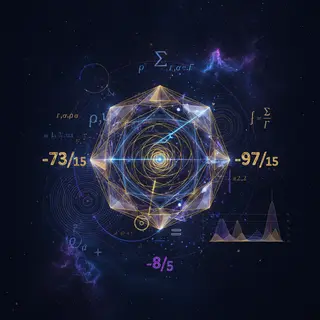
publishedDerives an affine conversion identity expressing the adjoint Atiyah–Patodi–Singer rho invariant of any irreducible flat unitary twist on S^3/Γ in terms of Kronheimer–Nakajima character sums, and applies it to the Poincaré homology sphere S^3/2I to recover the adjoint rho pair −73/15 and −97/15 whose difference −8/5 is supported exactly on the four ‘golden’ conjugacy classes. It further shows the E8 plumbing’s tautological bundles realize this Galois asymmetry as an exact charge difference while the raw mod-2/mod-4 homology and restriction-route surface terms are blind to it.
Twisted quantum modes on a conic Möbius band: bound states, holonomy, and a stable first positive level
publishedStudy of the Laplace–Beltrami operator on sections of the orientation line bundle over a constant-curvature Möbius band with a cone-point defect, comparing the Friedrichs extension and the sector-regular bridging (renormalized 2D point interaction) family. The cone interaction fixes an extension-dependent ground state (Friedrichs has a discontinuous zero mode; bridging produces a logarithmic negative bound state), while the first positive eigenvalue is stable across these realizations and admits explicit closed-form values with a width-driven mode crossing.

Coexact spectral gaps of flat bundles on homogeneous spherical space forms
publishedWe determine the lowest nonzero eigenvalue of the Hodge Laplacian on coexact E_τ-valued 1-forms over homogeneous spherical space forms S^3/Γ: it equals q_τ^2/R^2, where q_τ is the first coexact occurrence level of constituents of τ, given (in the bipartite case) by their McKay graph distance. In particular, for adjoint twists of irreducible SU(2) flat connections the gap is 4/R^2 across the ADE classification with the sole exception of the Galois-conjugate connection on the Poincaré homology sphere S^3/2I, whose gap is 36/R^2; the result follows from Ikeda–Taniguchi spectra, the Lauret–Miatello–Rossetti descent, and the McKay correspondence.
Apparent Phantom Crossing as Template Bias: A Bounded-Clock Deformation of LCDM
publishedThe paper constructs a one-parameter bounded-clock deformation of flat \LambdaCDM ("\Lambdacos") that is provably non-phantom under a fiducial-matter diagnostic but produces apparent phantom crossings when analyzed with common two-parameter templates (e.g., CPL). It fits \Lambdacos to Pantheon+ and DESI DR2 BAO, finding s0 < 0.19 (95% CL) and that the template-induced CPL distortion is structurally present but modest, demonstrating template bias as an explanation for some apparent phantom behavior.
Black Double Zero's
publishedThis paper proposes that a black hole is a ‘double zero’ in a scaling law: the phase position Θ reaches a domain boundary and the local hierarchy Ω_H collapses simultaneously, causing the observable sampling amplitude C(Θ) to vanish. It connects this scaling description to spectral geometry on the Poincaré homology sphere—identifying Hawking radiation and Reidemeister torsion as the surviving first-order signals at the double zero—and motivates area-law entropy while leaving the A/4 coefficient open.
The Waltz: Λ Note to Einstein's Field Equations
publishedThe paper derives Newton's constant G from topology by identifying the cosmological constant Λ as the ground eigenvalue of a Möbius surface embedded in S^3; Gauss–Codazzi converts this 2D eigenvalue to Λ_obs = 3/R^2 and, together with a topology-derived fermion mass spectrum that fixes the energy scale μ_Λ, yields G = 3 c^4/(8π R^2 μ_Λ^4), reportedly matched to observations at the percent level. It further reframes dark matter and dark energy as geometric sectors at different manifold depths, removing the need for additional particle content.
Spectral Inaccessibility on the Poincaré Homology Sphere
publishedFor the Poincaré homology sphere S^3/2I, every intrinsic admissible spectral construction (from natural Laplacians, Dirac/signature operators, torsion, equivariant eta, and their finite algebraic combinations) can read Dirichlet and Hecke L-function data but cannot constrain zeros of any individual L-function. Any vanishing of such a construction is explained by one of four exhaustive obstructions — shifted-value coincidence, encoding degeneracy, framework mismatch, or character completeness — rather than by forcing L-function zeros.
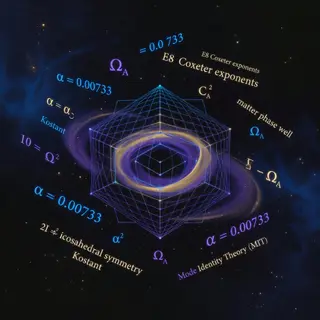
α fine structure: Λ Minimum Step to Mode Identity
publishedUsing Mode Identity Theory, the paper derives the fine-structure constant and the three Standard Model gauge couplings from a single topological postulate: an icosahedral grid and a matter phase well (13/60) together with a fractional Ω_Λ exponent. The formula yields α = 0.00733 (0.5% error) and similarly close predictions for α_s and α_W, with accompanying structural selection and uniqueness scans.
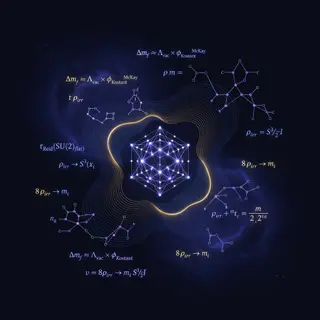
Fermion Mass Formula from Spectral Geometry on S³/2𝐼
publishedConstructs a fermion mass formula from spectral geometry on the quotient S³/2𝐼 that multiplies a vacuum-energy scale by a Kostant geometric phase, a McKay-graph hierarchical exponent tied to the cosmological constant, and Reidemeister torsion from three flat SU(2) connections. Applied to 8 irreducible representations across 3 vacua it produces 24 mass predictions, 10 of which are assigned to Standard Model fermions (9 within a factor of 3 and 3 within 6%).
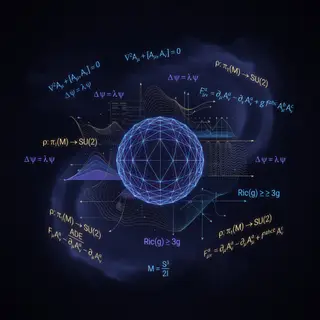
Easy Money: Yang-Mills on the Poincare Homology Sphere
publishedThe Millennium Prize asks whether pure Yang–Mills theory on ℝ⁴ has a positive mass gap. On flat space, confinement must emerge dynamically. On the Poincaré homology sphere M = S³/2I, the answer is forced by geometry. Positive Ricci curvature provides a universal floor. The finite fundamental group yields exactly three isolated vacua: trivial, standard, and Galois conjugate. The McKay correspondence for the extended E₈ diagram filters the spectrum at each vacuum, producing a ninefold enhancement at the Galois sector. The same curvature that enters the Λ conversion guarantees confinement.
CMB Anomalies from Topology
publishedThree large‑angle CMB features have persisted across COBE, WMAP, and Planck with no explanation within ΛCDM. The Möbius embedding in S³ restricts the mode spectrum at large scales, breaks even‑odd symmetry through the non‑orientable identification, and defines a preferred axis as the twist normal. What has been called the “axis of evil” may be the universe revealing the geometry of its beginning.
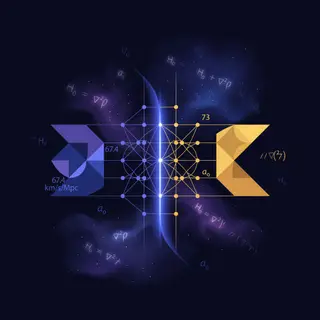
H₀ Local: Hubble Tension as Phase Field
publishedMeasurements of the Hubble constant have split into two persistent camps: the cosmic microwave background gives 67.4 km/s/Mpc; local distance ladders give 73. The discrepancy survives every systematic check and every independent method. Mode Identity Theory resolves the tension through the phase field: observers embedded in galactic structure sample from a shifted position on the 120‑domain. The shift is one bosonic step, Θf = 2/120, and the logarithmic slope of the phase operator at the H₀ well converts that step into an 8.4% increase. Both measurements are correct. They sample different positions on the same wave.
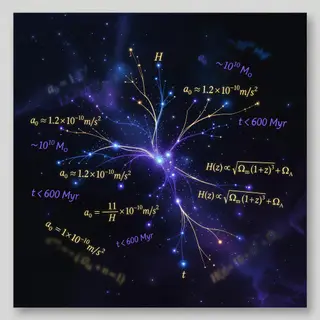
a₀ Evolving: High-Redshift Galaxy Masses
publishedJames Webb has found galaxies too massive, too early. Stellar masses of ∼10¹⁰ M⊙ within 600 Myr of the Big Bang require star formation efficiencies exceeding unity under ΛCDM, a physical impossibility. Mode Identity Theory predicts that the MOND acceleration scale a₀ is an edge mode (n = 1) referencing the evolving Hubble horizon: a₀(z) = a₀(0) × H(z)/H₀. At z = 10, this gives a₀ ≈ 20× the local value, enhancing gravitational binding and accelerating structure formation without new physics. Critically, MIT predicts a₀ evolves while Λ remains fixed: the inverse of standard assumptions. Both predictions are independently testable.
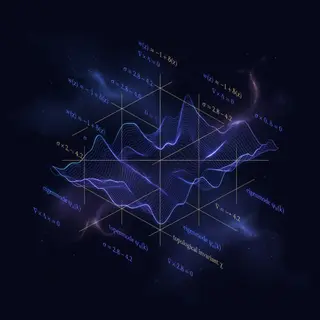
w Evolving: Λ Topological Resolution
publishedDESI reports mounting evidence (2.8–4.2σ) that the dark energy equation of state w evolves with redshift. If true, it would overturn the cosmological constant and reshape modern physics. Mode Identity Theory says the change is an illusion: Λ is fixed by the geometry of the universe, and what looks like evolution is the observer’s phase position on a standing wave. The “phantom crossing” through w = −1 arises as a template artifact rather than exotic physics. Tested against DESI DR2 baryon acoustic oscillation data, the Pantheon+ supernova compilation, and a Planck‑calibrated CMB ruler prior, MIT with locked parameters achieves ΔAIC = −2.1 over ΛCDM at the same parameter count.
Λ Ground Mode of the Cosmic Boundary
publishedEinstein introduced Λ in 1917 to hold the universe static. When Hubble proved expansion, he removed it, calling it his “biggest blunder.” A century later, standard cosmology revived Λ as dark energy. This note completes the arc: there is no dark energy nor mysterious force. Λ is set by the ground‑mode eigenvalue of the cosmic boundary; the geometry of the universe itself driving expansion. Einstein was right the first time, for reasons then unknown. The Möbius surface selects half‑integer modes; the lowest yields Λtop = 2/R², where R is the curvature radius of S³. The observationally inferred Λobs differs by a factor of 3/2, obtained through Gauss–Codazzi embedding under totally geodesic embedding and isotropy; the surface‑to‑eigenvalue identification is motivated from three directions.

The Surviving Ray
approvedThe paper shows how binary-icosahedral symmetry filters the spin-3 density interaction on S³/2I to a single nonradial projective ray, and derives the resulting quartic as an affine function of the top multipole. It also establishes spin-3 results on the selected interaction’s critical geometry and extrema, and analyzes local solution branches on the quotient.
Member since 3/21/2026