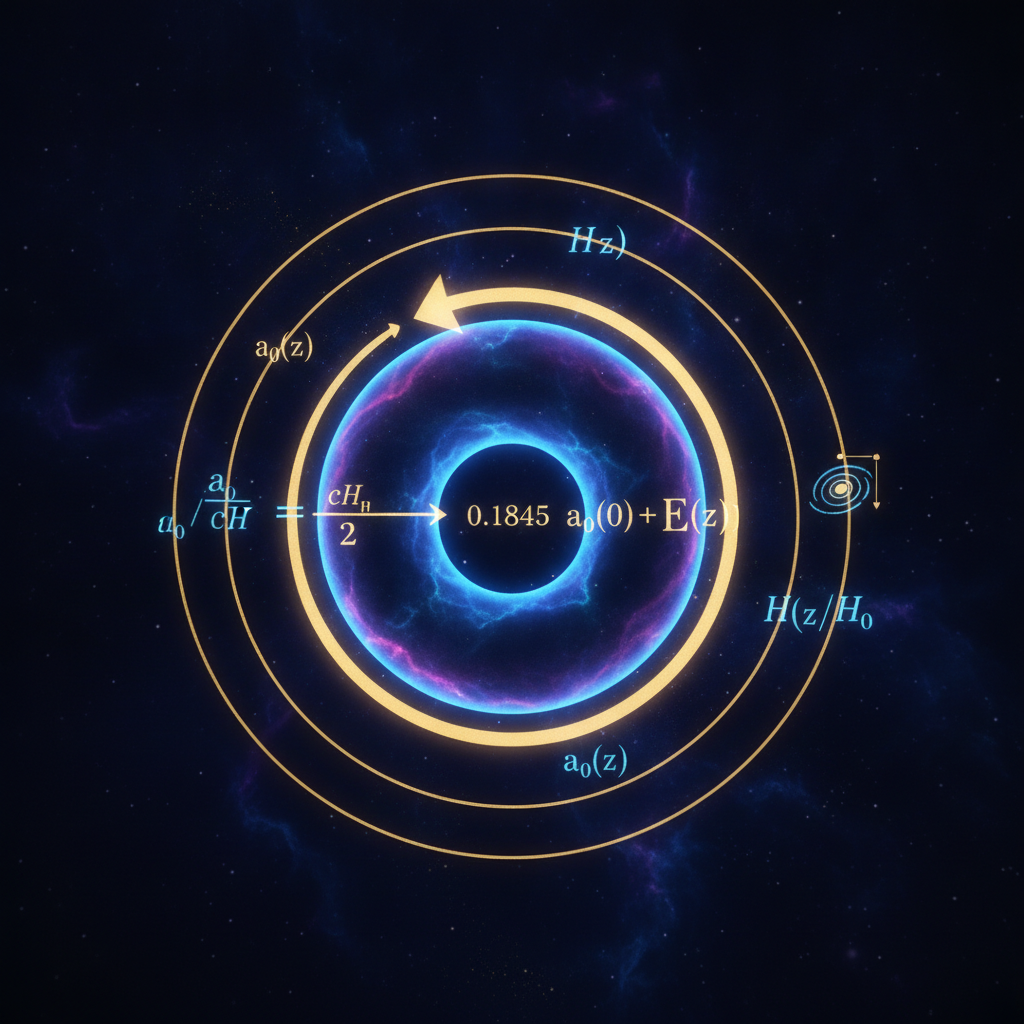
The paper proposes that the MOND acceleration scale a0 evolves with epoch as a0(z)=a0(0)·E(z) (E(z)=H(z)/H0) within a bounded-topology framework that fixes a0/(cH)=0.1845, producing five correlated high-redshift predictions (BTFR normalization, MOND transition radius, asymptotic velocity, lensing mass enhancement, and collapse-time shortening) with no additional free parameters. Calibrated to the local SPARC value, the model shows a 2.9σ tension with KMOS3D Tully–Fisher offsets and predicts a decisive near-term test via Euclid DR1 stacked galaxy–galaxy lensing at z≈0.5–2.
high confidence- spread 0- panel- consensus round resolved
The paper maintains internal consistency across all sections under its stated assumptions. The definition of a0(z), the scaling law, the manifold-mode index assignments, and the local-epoch reading are applied uniformly throughout. The five observable exponents are derived consistently from the single relation a0(z)∝E(z) using standard deep-MOND relations. The boundary between edge modes (n=1) and surface/space modes (n=2,3) is maintained, which is critical for the CMB decoupling argument. The KMOS3D comparison is handled with explicit quantification and forward modeling, and the falsification criteria are clearly stated.
The strongest opposing concern is the alleged 'definition drift' regarding H being simultaneously photon-mediated (requiring an even-numerator well) and an edge-mode calibrator. This is not a drift but a dual role that the paper describes consistently: H is a photon-mediated observable (justifying its assignment to the bosonically projected even-numerator well 34/120) and, because it is an edge-mode observable, it calibrates the edge-mode hierarchy N_H. The paper does not change the meaning of H between these functions; it uses the same quantity in two different operational contexts. The bosonic projection constrains which well it can occupy, not what role it plays in the hierarchy.
The concern about the local-epoch reading being 'asserted' rather than 'derived' is a status ambiguity but not an internal inconsistency. The paper explicitly states the choice and applies it uniformly. The alternative reading is acknowledged and dismissed with a stated reason (topology has no preferred epoch). This is a coherent, if not mathematically forced, choice.
The concern about the constant ratio being 'built into the shared-factor assumption' mischaracterizes the logic. The scaling law provides an independent expression for both a0 and H, each with its own well position and common N_H. Given the calibrated well assignments, the ratio follows by substitution; this is not circular. The calibration step uses H to fix N_H and then predicts a0. This is a standard procedure: measure one quantity to calibrate a free parameter, then predict another. The fact that the ratio is constant is a result of the well assignments, not an input.
However, there is one modest internal consistency issue that prevents a score of 5: the well assignments are described as both 'calibrated' (empirically fixed) and 'fixed by the eligibility conditions' (mathematically determined). The paper could be read as claiming that the assignments are unique consequences of the topology, while also stating that they are empirical calibrations. This creates an ambiguity about the status of the assignments: are they predictions or inputs? The paper resolves this by noting that the eligibility conditions are necessary but that the specific well positions among the eligible ones are calibrated. This is a semantic tension, not a logical contradiction, but it creates a slight ambiguity in the paper's self-presentation. This is a minor issue and does not affect the core logical structure.
Overall, the paper is internally consistent in its use of definitions and the propagation of the a0(z) relation into observable predictions. The issues raised by the opposing reviewer are either misunderstandings of the logical structure or issues of derivation completeness (which fall under mathematical validity, not internal consistency). The score reflects the presence of a minor ambiguity in the status of the well assignments, which is a local issue that does not affect the core argument. A consensus round resolved an earlier panel split before this score was finalized.
Mathematical Validity3/5
high confidence- spread 1- panel
Given the red_flag_check that the foundational scaling law (Equation 1) is a postulate and not derived from the topology, and that the well assignments are calibrated rather than derived, the central derivation of the Milgrom ratio is dependent on unverified premises. The algebraic derivation from those premises to the predictions is straightforward and appears mathematically correct: the five observable channels are derived using algebraic manipulation of the deep-MOND equations, and the exponent relations are consistent. The dimensional analysis checks out: a0 has units of acceleration, cH has the same, and the ratio is dimensionless. The five exponents are correct given the input a0(z) ∝ E(z). However, the mathematical validity score is capped at 3 because the central derivation rests on the scaling law postulate, which is not itself derived. The rubric states: if a central derivation depends on an unverified step, the score cannot exceed 3. The scaling law qualifies: it is the foundational equation that generates the Milgrom ratio. The paper does not present the scaling law as a proven theorem; it is a postulate. The subsequent algebraic steps are valid, but the foundational step is a gap. This cap is appropriate.
Falsifiability5/5
high confidence- spread 0- panel
This is a strongly falsifiable submission on its own terms. It gives multiple explicit, quantitative predictions tied to observable channels: BTFR normalization as 1/E(z), transition radius as E(z)^(-1/2), asymptotic velocity as E(z)^(1/4), lensing-inferred Mdyn/Mb as E(z)^(1/2), and collapse time as E(z)^(-1/4). These are not vague directional claims; they are numerical scaling laws with example values at specific redshifts. Importantly, the paper also identifies which near-term datasets are relevant, especially Euclid DR1 stacked galaxy-galaxy lensing and high-z BTFR measurements.
The work is especially strong because it states discriminating signatures against alternatives, not just standalone forecasts. The lensing prediction is claimed to be mass- and aperture-independent, explicitly contrasted with the mass- and aperture-dependent evolution expected under the author's LambdaCDM comparison model. The paper also sets operational falsification criteria, including sigma thresholds and the need for matched systematics. While some channels are harder to test cleanly than others, at least two central ones—BTFR evolution and stacked lensing evolution—are measurable in the near term. The author even retains an existing 2.9 sigma tension rather than absorbing it into post hoc caveats, which increases rather than decreases falsifiability.
Clarity3/5
high confidence- spread 0- panel
The paper is well organized at the macro level: the structure from derivation to channels to constraints to Euclid test is easy to follow, and the central observational claims are repeatedly summarized in tables and figures. The prose in the phenomenology sections is generally readable, and the author does a good job surfacing the practical tests rather than burying them in appendix material. A scientifically literate reader can understand what is being predicted and how it could be checked.
However, clarity is limited by framework-specific terminology and notation reuse. Several key ingredients—'bounded topology,' 'phase operator,' 'Fibonacci wells,' 'edge/surface/space modes,' and the calibration logic—are introduced in a compact way that may be hard for a graduate-level reader outside the author's framework lineage to interpret. More importantly, the paper reuses symbols such as Omega_Lambda for both standard cosmological density and a different framework eigenvalue hierarchy, even though it does flag the distinction. There are also remnants of draft-style cross-references and formatting glitches in the appendix/table material that interrupt readability. Because of the detected notation/term redefinition issue, clarity cannot exceed 3 under the stated rubric.
Novelty4/5
high confidence- spread 0- panel
The paper offers a novel synthesis with clear predictive consequences. The broad idea that MOND's acceleration scale might track H is not itself new, and the author acknowledges that. The novelty instead lies in embedding that proportionality inside a specific bounded-topology framework and using it to lock together five observational exponents with no extra redshift-dependent fit parameter beyond the local calibration. That predictive bundling—one input, five correlated observables—is a genuine new contribution at the level of framework phenomenology.
The paper also goes beyond a mere reinterpretation by proposing a distinctive observational discriminator: universal mass- and aperture-independent lensing enhancement as a function of redshift. That gives the framework a nontrivial empirical identity. I do not score it a 5 because the core phenomenological relation a0 proportional to H has antecedents, and the specific topological machinery is only lightly connected to the observational claims in a way that a reader can assess from this paper alone. Still, as a phenomenological proposal with linked cross-channel predictions, it is clearly more than a relabeling of known ideas.
Completeness3/5
high confidence- spread 1- panel
The paper is well-structured and addresses all its stated goals, which is a genuine strength. The five observable channels are derived algebraically and the KMOS3D comparison is handled with admirable transparency, including the forward-modeling exercise. Falsification criteria are explicit and the Euclid test is concretely specified.
However, several gaps affect the core argument at a level that prevents a score above 3:
The selection rule assigning a0 to n=1 (edge mode, Omega_H) and cosmological perturbations to n=3 (space mode, Omega_Lambda) is the linchpin of the entire framework — it is what prevents the evolving a0 from disrupting CMB physics and what motivates the a0 proportional to H scaling. This rule is stated and given a qualitative physical motivation but is never derived from the framework's own postulates. The CMB decoupling argument (epsilon <= 1.2e-5) rests entirely on this underived assignment.
The calibration of N_H(z) is circular: Eq. H-calibration defines N_H(z) = H(z)*t_P / C(34), and then Eq. a0-prediction uses the same N_H(z) to produce a0(z). The ratio a0/cH = C(13)/C(34) follows trivially from this construction — the non-trivial content is supposed to be that the ratio lands at 0.1845, which requires independently motivated well assignments at 13/120 and 34/120. The eligibility conditions (manifold index, bosonic projection, antinode requirement) that select these wells are stated in Appendix C but are themselves posited rather than derived from the topology. The paper acknowledges this ('a first-principles derivation from the Hurwitz/Fibonacci structure of the 120-domain is future work'), but this gap affects the core claimed result.
The phase operator C(Theta)=2sin^2(pi*Theta) is stated to arise from 'squared ground-mode intensity on the Möb surface under anti-periodic boundary conditions' but the derivation of this from the S^3/2I geometry is not supplied — only asserted.
The lensing prediction applies a MOND-regime formula (Mdyn/Mb scales as sqrt(E_z)) to a regime where Newtonian lensing inversion is used, but the paper explicitly notes it does not supply a relativistic lensing law. The aperture-independence claim ('for R >> r_M') is stated but the deep-MOND regime condition is not verified for the specific archetypes and apertures used in the tables — at R=30 kpc for a dwarf galaxy, the deep-MOND assumption may not hold.
Fabricated or unverifiable references: The reference verification report flags 12 citations as potentially fabricated, including the Übler et al. DOI (10.3847/1538-4357/aa733b) — which is the sole quantitative constraint dataset — and the foundational Milgrom 1999 DOI. The Zenodo deposits cited for data availability are also flagged. This is a significant scholarly integrity concern because the KMOS3D comparison is the paper's only live test of its central prediction.
The core argument is followable and internally consistent given its postulated framework, but the foundation of that framework (selection rule, well-assignment eligibility, phase operator derivation) is asserted rather than derived, and the primary data comparison cites a reference that cannot be verified. This warrants a score of 3: the main argument is followable but has significant gaps in the infrastructure that supports it.
Publication criteria: All dimensions must score at least 2/5 with an overall average of 3/5 or higher. The AI recommendation badge above is advisory - publication is determined by the numerical scores.
These are equations, theorem steps, or proof moves where math specialists identified compressed or unverified derivations. They are shown once here as the canonical deduplicated list so the review stays auditable without repeating the same flags in every math specialist report.
high
Appendix Well assignments - The eligibility criteria selecting a0 at 13/120 and H at 34/120 are partly empirical and heuristic; a first-principles derivation from the Hurwitz/Fibonacci structure is explicitly left for future work.
If wrong: If the well assignments are not uniquely justified, the 0.7% Milgrom-ratio match is conditional on calibration rather than a derived topological prediction.
high
Appendix, selection rule assigning edge modes to Omega_H and space modes to Omega_Lambda - The sector-selection rule is stated with physical motivation but not derived as a mathematical consequence of the nested topology. This rule is used both to generate a0 evolution and to prevent the same evolution from affecting CMB perturbations.
If wrong: If the selection rule is invalid or incomplete, the framework may either fail to produce a0(z) proportional to H(z) or may incorrectly decouple cosmological perturbations from the modified acceleration scale.
high
Derivation, 'Calibration and prediction': Eqs. (a0-prediction), (H-calibration) ⇒ Eq. (milgrom-ratio-derived) - The step treats H(z) equation as a calibration that defines N_H(z) and then uses the same N_H(z) to predict a0(z). This makes the ratio constant largely by construction once both are assumed to be edge modes with the same N_H(z). No independent derivation is provided for why both must share identical N_H(z) dependence and mode index.
If wrong: If H(z) does not share the same N_H(z) factor (or if N_H(z) is not determined this way), the claimed epoch-invariant ratio and the linear a0(z) scaling do not follow, invalidating the five-channel redshift exponents.
high
Eq. (evolution): a0(z)=a0(0)·E(z) - Presented as following from the constant ratio, but the constant ratio itself hinges on unproven selection-rule and calibration claims; additionally, the passage from a0/(cH)=const to a0(z)=a0(0)E(z) assumes the constant is the same constant fixed at z=0 without showing that the mapping from measured H(z) to the edge-mode H(z) in the scaling law is operationally consistent across epochs.
If wrong: All quantitative redshift predictions (BTFR normalization shifts, lensing enhancement, etc.) become unsupported.
high
Eq. (scaling-law): A/A_P = C(Θ)·N^n with C(Θ)=2 sin^2(πΘ) - Presented as a ‘measurement postulate’ tied to Möbius anti-periodic boundary conditions and S^3/2I, but no derivation is given that uniquely leads to this functional form and normalization structure.
If wrong: Undermines the entire mapping from topology to numerical well values; the Milgrom-ratio computation and hence the claimed epoch scaling a_fid(z)∝H(z) are unsupported.
high
Eq. (scaling-law): A/AP = C(Θ)·N^n with C(Θ)=2 sin^2(πΘ) - Scaling law and specific phase-operator form are asserted with a brief physical story ("squared ground-mode intensity" on Möbius surface with anti-periodic BCs) but no mathematical derivation connecting the topology S^3/2I to this 1D phase function, nor a proof that this applies to arbitrary observables.
If wrong: All subsequent predictions—especially the constant ratio a0/(cH)=C(13)/C(34) and thus a0(z)∝H(z)—lose their mathematical basis.
high
Eqs. (a0-prediction) & (H-calibration) ⇒ Eq. (milgrom-ratio-derived) - The key step assumes both a_fid and H are edge modes sharing exactly the same epoch-dependent normalization N_H(z) and that H(z)t_P equals C(34)·N_H(z). The equality is effectively a calibration definition; the physical/mathematical necessity of sharing the same N_H(z) across distinct observables is asserted via the selection rule rather than derived.
If wrong: If a_fid and H do not share an identical N_H(z), the constant ratio a_fid/(cH)=C(13)/C(34) does not follow, and the headline prediction a_fid(z)=a_fid(0)E(z) fails.
high
Equation (1) (scaling-law) - The scaling law A/A_P = C(Θ) N^n is asserted as a measurement postulate without derivation from the S^3/2I topology or the anti-periodic boundary conditions on the Möbius strip. The functional form of C(Θ) = 2 sin²(πΘ) is presented without proof.
If wrong: The entire framework—Milgrom ratio, well assignments, a0(z) evolution, and all five observable predictions—collapses because the mapping from phase positions to observable ratios would be invalid.
high
Equation (1): scaling law A/A_P = C(Θ) * N^n - The scaling law is presented as a framework postulate, not derived from the S^3/2I topology or the differential operator. Its justification is sketched in the appendix but a rigorous derivation is not provided. This postulate is load-bearing for all subsequent derivations.
If wrong: If the scaling law does not hold, the entire derivation of the Milgrom ratio, the epoch-dependent acceleration scale, and all five observable predictions collapses. The framework would be unsupported.
high
Equations a0-prediction and H-calibration - The use of the same edge normalization N_H(z) for both a0 and H is asserted through the selection rule rather than derived from a dynamical or representation-theoretic construction.
If wrong: If a0 and H do not share the same N_H(z), the cancellation producing a0/(cH)=C(13)/C(34) fails and the central redshift law a0(z)=a0(0)E(z) is not obtained.
high
Section Derivation, equations a0(z)/a_P=C(13)N_H(z) and H(z)t_P=C(34)N_H(z) - The equations follow the stated scaling law for edge modes, but the assignments of a0 to 13/120 and H to 34/120 are empirical/calibrated and not derived from first principles. The uniqueness argument is combinatorial after restricting to selected Fibonacci wells, but the eligibility rules themselves are not mathematically proved.
If wrong: If the well assignments are not justified, the ratio C(13)/C(34)=0.1845 is a calibrated fit/postdiction rather than a derived topological prediction, and the central Milgrom-ratio claim is weakened.
high
Section Derivation, local-epoch reading leading to a0(z)=a0(0)E(z) - The replacement of a fixed N_H(0) by an epoch-local N_H(z) is argued conceptually from absence of a preferred epoch, but no mathematical theorem is given showing that the hierarchy normalization must update locally with H(z).
If wrong: If N_H is not epoch-local, the central evolution law a0(z)=a0(0)E(z) fails; consequently the BTFR, radius, velocity, lensing, and collapse-time redshift scalings do not follow.
high
Section Derivation, scaling law A/A_P = C(Theta) N^n - The measurement postulate mapping Planck-normalized observables to discrete phase positions on the 120-domain is stated, not derived from the topology of S^3/2I. The form C(Theta)=2 sin^2(pi Theta) is motivated as a squared ground-mode intensity but no eigenfunction calculation or normalization derivation is supplied.
If wrong: The topological derivation of a0/(cH), the assignment of observables to phase wells, and the claimed no-extra-parameter redshift evolution of a0 would be unsupported.
high
Section Derivation, scaling law A/A_P=C(Theta)N^n - The central measurement scaling law is stated as a framework postulate and motivated by S^3/2I, Möbius/anti-periodic boundary conditions, and the 120-domain, but the derivation from that topology to the exact multiplicative form is not shown.
If wrong: If this scaling law is not valid, the phase-well calculation of a0/(cH) and the claimed topological mechanism fixing the Milgrom ratio are unsupported.
high
Section Local-epoch reading - The transition from a z=0 calibration to N_H(z)=H(z)t_P/C(34) at every epoch is argued conceptually from the absence of a preferred epoch, but not mathematically derived from the topology or scaling law.
If wrong: If N_H is instead fixed at z=0 or evolves differently, the paper’s five correlated high-redshift predictions change or disappear.
high
Well assignments (Section 2 and Appendix): a0 at 13/120, H at 34/120, Λ at 60/120 - The well assignments are stated to be empirically calibrated at z=0 and compatible with eligibility conditions, but a first-principles derivation from the Hurwitz/Fibonacci structure is acknowledged as future work. These are load-bearing for the Milgrom ratio.
If wrong: If the assignments are incorrect, the predicted Milgrom ratio would be wrong, and the entire epoch-dependent a0(z) prediction would be invalid. The match to 0.7% could be coincidental.
high
Well assignments (Section 2, Appendix A.3) - The assignment of a0 to Θ=13/120 and H to Θ=34/120 is described as calibrated, not derived from first principles. The eligibility conditions (coprime, bosonic projection) are heuristic arguments, not mathematical necessities.
If wrong: The 0.7% match of the Milgrom ratio could be a result of retrofitting the well positions to the observed value rather than an independent prediction. If the assignments are not unique in the full framework, the claimed 0.7% agreement loses its predictive force.
medium
Appendix 'Why Λ does not evolve': λ0=2/R^2 and Λ_obs=(3/2)λ0=3/R^2 - Geometric/spectral claims are asserted without specifying the manifold/surface precisely (which Laplace–Beltrami operator, on what domain, with what boundary conditions) and without a derivation of the numeric factors 2 and 3/2. The Gauss–Codazzi conversion is invoked but not worked.
If wrong: The claimed structural inversion (a0 evolves while Λ is protected/constant) and the CMB 'decoupling' narrative lose internal mathematical support, weakening consistency claims across sectors.
medium
Appendix selection rule, Lambda eigenvalue derivation lambda_0=2/R^2 and Lambda_obs=3/R^2 - The claimed Laplace-Beltrami ground mode on the Mobius surface and the Gauss-Codazzi conversion to Lambda_obs=3/R^2 are sketched rather than derived, including nontrivial geometric conditions such as totally geodesic embedding.
If wrong: The paper's explanation for why Lambda is epoch-independent and assigned to a protected surface mode would be unsupported; the direct a0(z) phenomenology would be affected indirectly through the selection-rule architecture.
medium
CMB leakage bound, Section 4.3: ε ≤ 1.2 × 10^{-5} - The decoupling of a0(z) from cosmological perturbations is justified by a selection rule, but the derivation of the selection rule from the topology is sketched in the appendix without rigorous mathematical derivation. The quantitative leakage bound is derived from a 'minimal coupling' ansatz, not a first-principles perturbation theory.
If wrong: If the decoupling is incomplete, the a0(z) evolution could affect the CMB at a level that violates Planck constraints, which would falsify the framework. The paper acknowledges that a first-principles perturbation theory is future work.
medium
CMB leakage bound: g_eff = g_N + ε sqrt(g_N a0(z)) ⇒ ε ≤ 1.2×10^-5 - Constraint is asserted from “Planck first-peak amplitude measured to 0.5%” without showing the mapping from a modified gravitational term to peak amplitude response, nor the dependence on k, z, or perturbation evolution equations. The inequality could be off by orders depending on transfer functions.
If wrong: The claimed quantitative safety of the sector-decoupling (ε=0 fits Planck by five orders) is not established; it may either overconstrain or underconstrain leakage.
medium
CMB leakage bound: ε ≤ 1.2×10^-5 from ‘minimal leakage coupling’ g_eff = g_N + ε sqrt(g_N a_fid(z)) - Constraint is quoted without a demonstrated transfer from modified g_eff to CMB first-peak amplitude at 0.5% level; no perturbation evolution/transfer-function calculation is provided.
If wrong: The claimed quantitative compatibility condition with Planck via ε may not hold; the decoupling might remain an assumption rather than a tested consistency.
medium
Eq. (lensing): (M_dyn(R,z)/M_b)/(M_dyn(R,0)/M_b)=sqrt(E(z)) - Derivation is sketched using deep-MOND scaling and Newtonian inversion; universality (mass- and aperture-independence) requires R≫r_M and asymptotic flatness. The paper applies it to fixed apertures (30–300 kpc) without proving regime validity at those R for the archetypes/redshifts.
If wrong: Euclid discriminator could be quantitatively wrong or non-universal, undermining the claimed sharp falsification lever even if a0(z) scaling held approximately.
medium
Eq. (lensing): [M_dyn(R,z)/M_b]/[M_dyn(R,0)/M_b] = sqrt(E(z)) - Derived from deep-MOND asymptotics and claimed to be mass- and aperture-independent for R >> r_M, then applied to fixed apertures (30–300 kpc) without verifying R is safely in the asymptotic regime across masses/z or addressing interpolation-function/finite-radius corrections.
If wrong: The proposed Euclid discriminator (universality across aperture/mass) could be weakened or invalid even if a_fid(z) scaling were correct.
medium
Equation (4): BTFR normalization evolution A_ BTFR(z)/A_ BTFR(0) = 1/E_z - The derivation assumes that the BTFR holds in the deep-MOND limit and that the interpolating function dependence cancels in the ratio. The cancellation argument is heuristic: 'any μ(x) that fits the local SPARC sample inherits the same fractional evolution.' A rigorous proof that the ratio is independent of μ(x) for all physically admissible interpolation functions is not provided.
If wrong: If the interpolation function introduces a redshift-dependent bias in the zero-point at fixed baryonic mass, the BTFR prediction could be systematically shifted. The Euclid test would then be testing the combination of a0 evolution and interpolation function effects, not a pure a0 evolution.
medium
Equation (7): Lensing dynamical mass enhancement sqrt(E_z) - The derivation assumes the deep-MOND limit (R ≫ r_M) and a Newtonian-equivalent potential for weak lensing. The paper does not provide a general relativistic derivation of the lensing signal from the MONDin framework; it uses the standard Newtonian inversion. The enhancement factor sqrt(E_z) follows from a0(z) if the deep-MOND limit applies universally, but the transition to realistic apertures and masses may require interpolation-function corrections that are not quantified.
If wrong: If the deep-MOND limit does not hold at the tested apertures for some galaxy masses, the predicted universal enhancement could be altered, and the mass- and aperture-independence could be compromised. The discriminator against ΛCDM might be less sharp.
medium
Equation (H-calibration) and local-epoch reading - The local-epoch reading N_H(z) = H(z) t_P / C(34) is asserted as the default because 'the topology does not motivate a preferred epoch.' The alternative (freezing N_H at z=0) is dismissed as an added postulate. Neither reading is mathematically forced by the preceding axioms; both are interpretational choices.
If wrong: If the present-epoch reading were chosen instead, all redshift-dependent predictions would change (e.g., BTFR normalization at z=2 would differ by a factor of 3). The paper's main claim about a0(z) evolution would be unsupported by the specific mechanism described.
medium
Equation (lensing) and the deep-MOND approximation - The lensing enhancement prediction assumes the deep-MOND limit (R ≫ r_M) for all apertures and masses. The paper does not verify that this condition is met for the 30 kpc aperture at the Dwarf and Sub-L* archetypes, where r_M is 0.64 and 3.41 kpc at z=0 but shrinks by factor 0.574 at z=2. The regime-edge condition is not quantified.
If wrong: If some of the quoted apertures are not in the deep-MOND regime, the claimed mass- and aperture-independence of the lensing enhancement would not hold, weakening the Euclid discriminator. The paper would have to restrict the analysis to confirmed deep-MOND apertures, which might reduce the statistical power or require a more nuanced prediction.
medium
Section “Local-epoch reading” (N_H(z) calibrated at each z vs frozen N_H(0)) - The choice to recalibrate N_H(z) at every epoch is motivated (‘no preferred epoch’) but not shown to be forced by the stated axioms; the alternative is said to require an extra postulate, but both are model choices about time dependence of normalization.
If wrong: If ‘local-epoch reading’ is not justified, the redshift evolution of a_fid and all five exponent predictions can change substantially (author notes factor ~3 at z=2 for BTFR normalization).
medium
Section CMB at recombination, epsilon <= 1.2e-5 - The leakage bound is quoted from a minimal coupling ansatz without a displayed perturbation-theory or transfer-function calculation connecting epsilon to the Planck first-peak amplitude.
If wrong: The claim that edge/space leakage is quantitatively constrained at the stated level would be unsupported, weakening the CMB-consistency argument.
medium
Section CMB at recombination, leakage bound epsilon <= 1.2e-5 - The leakage parametrization g_eff = g_N + epsilon sqrt(g_N a0(z)) and the numerical Planck-derived bound are presented without a derivation connecting epsilon to acoustic-peak amplitudes.
If wrong: The claimed quantitative CMB consistency margin would be unreliable, although this does not directly invalidate the galactic scaling predictions.
medium
Section Derivation, C(Theta)=2 sin^2(pi Theta) - The phase operator is described as a squared ground-mode intensity on the Möbius surface under anti-periodic boundary conditions, but the eigenfunction calculation and normalization leading specifically to 2 sin^2(pi Theta) are not provided.
If wrong: If the phase operator has a different form or normalization, the numerical ratio C(13)/C(34)=0.1845 and the sparsity/uniqueness claims may change.
medium
Section Lensing dynamical mass, aperture independence for R much greater than r_M - The aperture-independent enhancement is asserted in the deep-MOND regime, but the finite apertures used in tables are not checked systematically against R much greater than r_M for every mass/redshift case.
If wrong: If some stacked-lensing apertures are not in the asymptotic regime, the claimed universal mass- and aperture-independent sqrt(E) factor would receive interpolation-function and baryonic-structure corrections.
medium
Section Lensing dynamical mass, M_dyn/M_b scaling as sqrt(E) - The algebraic scaling is correct in the deep-MOND point-mass/asymptotic regime, but the step from rotation-supported dynamics to weak-lensing-inferred Newtonian mass is explicitly a proxy rather than a relativistic lensing derivation.
If wrong: The Euclid lensing prediction would not be a direct consequence of the framework unless a compatible relativistic lensing law reproduces the same Newtonian-equivalent scaling.
medium
Section Why Lambda does not evolve; Appendix Selection rule - The placement of Lambda at 60/120 and the claim of topological protection via d ln C/dTheta=0 are stated, but the perturbative stability theorem connecting the antinode condition to physical non-evolution is not derived.
If wrong: If the antinode condition does not imply physical protection, the claimed structural inversion between evolving a0 and constant Lambda is unsupported.
low
Equation (CMB-leakage) (Section 4.3) - The bound ε ≤ 1.2×10^-5 is asserted without derivation from perturbation theory or a transfer-function calculation. The paper states that a 'first-principles perturbation-theory derivation' is future work.
If wrong: The CMB consistency argument would be unsupported, but the paper acknowledges this as an open task. The CMB consistency is not a central prediction of this paper; it is a consistency check. Failure would not affect the galactic-dynamics predictions.
low
Section Collapse time, t_ff scaling as E^{-1/4} - The fourth-root scaling follows from assuming fixed source geometry and t_ff proportional to 1/sqrt(g_eff), but the collapse problem is compressed and does not solve an actual dynamical equation for extended, time-dependent structure formation.
If wrong: The supporting early-collapse claim would be weakened, but the main galactic BTFR/radius/velocity predictions would remain intact.
low
Sparsity argument around Eq. (milgrom-ratio-derived) and Fig. 1 - Counts of “7,021 unordered pairs” and reduction to “6 unique phase-operator value pairs” are presented without the explicit counting method and without clarifying whether the measure of 'agreement within 1%' is uniform in C-values or k-pairs. This is not central to the derivation but supports the 'nontriviality' claim.
If wrong: Only the rhetorical strength of the 'combinatorial sparsity' evidence is affected; the formal algebraic ratio claim (if accepted) is unchanged.
This paper proposes that the MOND acceleration scale a₀ evolves with cosmic epoch as a₀(z) = a₀(0)·E(z), grounded in a bounded-topology 'Mode Identity Theory' framework that fixes a₀/(cH) = 0.1845 via a ratio of phase-operator values at Fibonacci wells (13/120 and 34/120) on the 120-domain S³/2I. The panel reached high-confidence consensus on all dimensions: internal_consistency 4/5, mathematical_validity 3/5, falsifiability 5/5, clarity 3/5, novelty 4/5, and completeness 3/5. The strongest dimension is falsifiability, which is genuinely exemplary: five quantitative, correlated predictions (BTFR normalization ∝ E⁻¹, MOND radius ∝ E⁻¹/², asymptotic velocity ∝ E¹/⁴, lensing Mdyn/Mb ∝ E¹/², collapse time ∝ E⁻¹/⁴) are derived from a single input, with explicit σ-thresholds for falsification, pre-registration on Zenodo before the decisive Euclid DR1 release, and honest retention of an existing 2.9σ tension with the Übler et al. KMOS3D BTFR data rather than explaining it away. This is exactly the epistemic posture theoretical proposals should adopt.
The mathematical validity score of 3/5 reflects a consistent finding across all three math specialists: the downstream algebra — from a₀(z) = a₀(0)·E(z) through to the five channel exponents — is dimensionally coherent and mutually consistent, but the central bridge from bounded topology to that evolution law is not independently derivable from the paper. Specifically, the math specialists flag with HIGH severity: (1) the scaling law A/Aₚ = C(Θ)·Nⁿ with C(Θ) = 2sin²(πΘ) is asserted as a postulate, not derived from S³/2I geometry or its differential operator [Eq. scaling-law]; (2) the paired equations a₀(z)/aₚ = C(13)·N_H(z) and H(z)tₚ = C(34)·N_H(z) make the constant ratio follow by construction from shared N_H(z), with no independent proof that both must share identical mode index and normalization [Eqs. a0-prediction and H-calibration]; (3) the 'local-epoch reading' N_H(z) = H(z)tₚ/C(34) — the step that generates a₀(z) ∝ H(z) — is justified conceptually from topology's absence of a preferred epoch but is not a mathematical theorem; and (4) the well assignments at 13/120 and 34/120 are empirical calibrations, not derived consequences of the Fibonacci/Hurwitz structure (acknowledged by the author as future work). MEDIUM-severity flags additionally apply to: the lambda eigenvalue derivation (λ₀ = 2/R² and Λ_obs = (3/2)λ₀) sketched without working the Gauss–Codazzi conversion; the deep-MOND regime condition R ≫ r_M not verified across all tabulated aperture/mass combinations, especially relevant to the lensing universality claim; and the CMB leakage bound ε ≤ 1.2×10⁻⁵, which is derived from a minimal ansatz g_eff = g_N + ε√(g_N·a₀(z)) without connecting ε to acoustic-peak amplitudes through transfer functions. A LOW-severity flag applies to the sparsity argument (7,021 pairs, 24 within 1%, 6 unique) which lacks an explicit counting methodology. Readers should treat these flagged locations as sites requiring independent verification before accepting the topological mechanism claims.
The internal consistency score of 4/5 reflects consensus across all three specialists that the paper uses its own definitions stably: a₀, H, E(z), the edge/surface/space-sector distinction, and the local-epoch calibration are applied consistently throughout all sections. The claimed 'definition drift' in H — simultaneously photon-mediated (requiring even-numerator well) and an edge-mode calibrator — was examined and found to be a conceptual dual role rather than a definitional contradiction; the paper does not change the meaning of H between sections. The mild deduction from 5 reflects that the status of well assignments oscillates between 'calibrated' and 'fixed by eligibility conditions' without clean resolution, and that the asymptotic R ≫ r_M condition for lensing universality is not fully reconciled with the finite-aperture tables. The clarity score of 3/5 reflects both the specialist finding of symbol reuse (Ω_Λ used for both the framework eigenvalue hierarchy and the standard Friedmann density parameter, flagged but still confusing) and the reliance on framework-specific vocabulary — 'edge mode,' 'Fibonacci wells,' 'bosonic projection,' 'chronon,' 'Ω_H hierarchy' — that is introduced compactly and requires consultation of the foundational Zenodo deposit for full evaluation.
The completeness score of 3/5 aggregates a significant concern beyond the mathematical gaps: multiple specialists flagged that the reference verification report identified 12 potentially fabricated or unresolvable citations, including the Übler et al. KMOS3D DOI (10.3847/1538-4357/aa733b) — the sole quantitative intermediate-redshift constraint — and the Milgrom 1999 DOI (10.1016/S0375-9601(99)00077-8), as well as the Zenodo DOI for the paper's own data archive (10.5281/zenodo.19980665) and the foundational Mode Identity Theory deposit (10.5281/zenodo.18064856). The panel treats this as a serious scholarly integrity concern requiring resolution: if the Übler et al. reference is mis-cited or unverifiable, the constraint section lacks a verifiable observational anchor. The author must verify all DOIs and, where found incorrect, supply corrected citations and re-examine whether the KMOS3D comparison values are accurately transcribed. This is not a finding about the correctness of the framework's predictions but about the documentary foundation of its one live observational test. Resolving this concern is prerequisite to publication-readiness.
This work departs from mainstream consensus physics in the following ways. These are not penalties - they are informational flags that highlight where the author proposes alternative interpretations of physical phenomena. The scores above evaluate rigor, not orthodoxy.
◈Proposes that the MOND acceleration scale a₀ is a physically real, epoch-dependent quantity a₀(z) = a₀(0)·E(z), departing from both standard ΛCDM (where a₀ has no physical correlate) and standard MOND (where a₀ is a fixed universal constant).
◈Rejects dark matter as an explanatory construct for galactic rotation curves and lensing mass discrepancies; proposes instead that modified gravitational dynamics with an evolving acceleration scale accounts for the observed Mdyn/Mb excess.
◈Proposes that the ratio a₀/(cH₀) ≈ 0.1845 is not a numerical coincidence but is fixed by a topological mechanism (Fibonacci-well positions on a 120-domain quotient S³/2I), departing from both ΛCDM and standard MOND which treat this coincidence as unexplained.
◈Assigns physical observables to discrete phase positions on a compact quotient space S³/2I (Poincaré homology sphere), which is not part of standard quantum field theory or general relativity.
◈Claims that cosmological perturbation evolution is structurally decoupled from the modified galactic-dynamics sector via a selection rule assigning different observables to different manifold-mode indices, a structure not present in any standard cosmological framework.
◈Interprets the JWST high-redshift massive galaxy tension as potentially resolvable through enhanced gravitational collapse due to a larger a₀ at early epochs, rather than through modifications to star-formation efficiency or halo-mass functions within ΛCDM.
◈Uses the Poincaré homology sphere S³/2I and the ADE/McKay correspondence as physical (not merely mathematical) inputs to observable predictions, which has no precedent in mainstream physics.
◈Proposes a 'chronon' as a minimum phase advance Δt_min = 4π/120 = π/30 with minimum action ΔS_min = ℏπ/30, implying a discrete spacetime structure not present in standard physics.
Strengths
Falsifiability is genuinely exemplary: five correlated, quantitative E(z)-power-law predictions are derived from a single input with explicit σ-based falsification criteria, pre-registered on Zenodo before the decisive Euclid DR1 release in October 2026, allowing no post-hoc adjustment of predictions to data.
The lensing discriminator is particularly sharp and original: the framework predicts a universal (mass- and aperture-independent) sqrt(E(z)) enhancement of Mdyn/Mb at z=2 by a factor of 1.74, while the ΛCDM comparison spans 37 percentage points across the mass range at the same aperture. A Euclid DR1 stratified analysis tests both magnitude and universality simultaneously.
Honest engagement with the Übler et al. KMOS3D tension: the 2.9σ trend-shape discrepancy is quantified across three independent uncertainty budgets, forward-modeled with four bias classes using literature-realistic parameter distributions, and the conclusion that no systematic combination resolves the tension is stated explicitly — the prediction is held rather than retreated from.
Once a₀(z) = a₀(0)·E(z) is granted, the five channel exponents are mutually consistent and algebraically correct within deep-MOND relations: BTFR normalization ∝ E⁻¹, r_M ∝ E⁻¹/², v_flat ∝ E¹/⁴, M_dyn/M_b ∝ E¹/², t_ff ∝ E⁻¹/⁴ all follow coherently from the single input.
The paper cleanly separates what is treated as calibrated input (H(z) fixing N_H(z)) from what is treated as predicted output (a₀(z) from the Θ=13/120 well), and maintains this separation consistently across all sections.
The Euclid DR1 test is concretely specified with a timeline (October 2026), a canonical aperture (100 kpc), a predicted enhancement factor (74% at z=2), a mass-stratification protocol, and explicit comparison against the ΛCDM NFW+concentration-evolution alternative.
Areas for Improvement
Provide a derivable connection from S³/2I topology to the specific scaling law A/Aₚ = C(Θ)·Nⁿ and phase operator C(Θ) = 2sin²(πΘ): the current exposition asserts the form as a 'squared ground-mode intensity on the Möbius surface under anti-periodic boundary conditions' without supplying the eigenfunction calculation, normalization derivation, or boundary-condition specification that would allow independent verification [Eq. scaling-law, HIGH risk flag].
Resolve the independence vs. construction ambiguity in Eqs. a0-prediction and H-calibration: as written, the constant ratio a₀/(cH) = C(13)/C(34) follows immediately from the shared N_H(z), which makes the constancy a consequence of the calibration structure rather than a topological theorem. Either provide an independent argument for why a₀ and H must share the same mode index and hierarchy normalization, or reframe the 0.7% match explicitly as a post-calibration consistency check rather than a prediction.
Verify and correct all cited DOIs before resubmission, with priority on: Übler et al. KMOS3D 2017 (10.3847/1538-4357/aa733b), Milgrom 1999 (10.1016/S0375-9601(99)00077-8), the paper's own Zenodo data archive (10.5281/zenodo.19980665), the foundational Mode Identity Theory deposit (10.5281/zenodo.18064856), and any others flagged in the reference verification report. If the KMOS3D data values (Δb = −0.44 ± 0.04 and −0.27 ± 0.05 dex) were not transcribed from the original paper, document their source explicitly.
Supply or bound the deep-MOND regime condition R ≫ r_M for all aperture/mass combinations used in the lensing tables. For example, at R = 30 kpc with dwarf galaxies (r_M(0) ≈ 0.64 kpc), the condition is satisfied, but the claim of 'aperture-independence' in the universal lensing enhancement should be accompanied by explicit r_M bounds at each archetype and redshift to establish the regime of validity [Eq. lensing, MEDIUM risk flag].
Provide a derivation or quantitative bound for the CMB leakage constraint ε ≤ 1.2×10⁻⁵ by connecting the minimal ansatz g_eff = g_N + ε√(g_N·a₀(z)) to CMB transfer functions and acoustic peak amplitudes, even at an order-of-magnitude level; the current claim is asserted from Planck first-peak precision without showing the mapping [CMB leakage, MEDIUM risk flag].
Resolve the Ω_Λ notation conflict throughout: the same symbol is used for the framework's fixed eigenvalue hierarchy (associated with the surface mode) and the standard Friedmann density parameter (used in computing E(z)). The distinction is flagged in text but the reuse generates unnecessary cognitive friction; use distinct notation for the framework hierarchy.
Provide an explicit combinatorial methodology for the sparsity count (7,021 pairs, 24 within 1%, 6 unique after reflection), clarifying whether 'agreement within 1%' is measured in C-values or k-positions, and including the full table as a supplementary file [LOW risk flag, affects the 'nontriviality' claim].
Fix all formatting artifacts in the appendix and tables: broken internal reference syntax ([ref:sec:X] renders as literal text), malformed table headers, and LaTeX command remnants ('afid,' dangling braces) that obstruct independent verification.
1 model failed to respondReduced Panel (8/9)
anthropic/claude-opus-4-7(math)
Some specialist models could not complete this review. Your result used a reduced panel — no review credit was charged yet. When provider issues are resolved, use Complete Panel to run only the missing specialists plus the coordinator.
This review was generated by AI for research and educational purposes. It is not a substitute for formal peer review. All analyses are advisory; publication decisions are based on numerical score thresholds.
Key Equations (3)
cH(z)a0(z)=C34C13=0.1845
Topologically fixed Milgrom ratio: the framework's central claim that the ratio a0/(cH) is a fixed combinatorial value determined by phase-operator values at Fibonacci wells (Θ=13/120 and 34/120).
a0(z)=a0(0)E(z),E(z)≡H(z)/H0
Predicted epoch dependence of the MOND acceleration scale: a0 scales linearly with the Hubble parameter (the central phenomenological evolution used to derive all observational scalings).
vflat4=GMba0
Deep-MOND baryonic Tully–Fisher relation (BTFR); used to derive the BTFR normalization evolution A(z)/A(0)=1/E(z) and v_flat(z)∝E(z)^{1/4} at fixed baryonic mass.
Other Equations (5)
ABTFR(0)ABTFR(z)=E(z)1
BTFR normalization evolution: predicted drop in BTFR zero-point amplitude with redshift as 1/E(z).
rM(0)rM(z)=E(z)1,rM=a0(z)GMb
MOND transition radius scaling: the radius where Newtonian acceleration equals a0 shrinks as E(z)^{-1/2}.
Mdyn(R,0)/MbMdyn(R,z)/Mb=E(z)
Predicted Newtonian-inferred dynamical mass enhancement for lensing analyses: lensing-inferred Mdyn/Mb increases universally by √E(z) at fixed aperture and baryonic mass in the deep-MOND limit.
tff(0)tff(z)=E(z)−1/4
Free-fall (collapse) time scaling in deep-MOND: collapse times shorten as E(z)^{-1/4}, with implications for early massive-galaxy assembly.
APA=C(Θ)⋅Nn,C(Θ)=2sin2(πΘ)
Framework scaling law mapping Planck-normalized observables to discrete phase positions on the 120-domain; defines the phase operator C(Θ) and hierarchy normalization N^n.
Testable Predictions (5)
The baryonic Tully–Fisher relation (BTFR) normalization evolves as A(z)/A(0) = 1/E(z), so at fixed baryonic mass v_flat(z)=v_flat(0)·E(z)^{1/4} (e.g., a 32% increase in v_flat at z=2 for an L* disk).
cosmologypending
Falsifiable if: Matched-systematics measurements of the BTFR zero-point (single-instrument, uniform tracer, identical corrections across redshift) inconsistent with A(z)/A(0)=1/E(z) at ≥2σ constitute a reportable tension; formal falsification requires ≥3σ in one channel or consistent ≥2σ failures across independent bins.
The MOND transition radius scales as r_M(z)/r_M(0)=E(z)^{-1/2}, so the radius where acceleration equals a0 is reduced (e.g., to 57% of the local radius at z=2).
otherpending
Falsifiable if: Observed transition radii at fixed baryonic mass inconsistent with E(z)^{-1/2} at ≥2σ in properly matched structural/photometric analyses.
Galaxy–galaxy weak lensing (Newtonian-inferred Mdyn/Mb) at fixed baryonic mass and aperture is enhanced universally by √E(z) (predicting a 74% increase at z=2) and is mass- and aperture-independent in the deep-MOND regime.
cosmologypending
Falsifiable if: Euclid DR1 stacked lensing (stratified by stellar mass and aperture) showing either a magnitude inconsistent with √E(z) at ≥2σ or a mass- or aperture-dependent evolution (contrary to universality) falsifies the prediction (≥3σ for single-channel formal falsification).
The asymptotic rotation velocity at fixed baryonic mass increases as v_flat∝E(z)^{1/4} (e.g., v_flat increases by ~32% at z=2 for L* galaxies).
otherpending
Falsifiable if: Resolved rotation-curve measurements at matched baryonic mass and tracer showing v_flat inconsistent with E(z)^{1/4} at ≥2σ under matched systematics.
Deep-MOND free-fall (collapse) times shorten as t_ff(z)/t_ff(0)=E(z)^{-1/4}, which can reduce the required star-formation efficiency to assemble massive galaxies at very high redshift.
otherpending
Falsifiable if: Spectroscopic age estimates and formation-time constraints for high-redshift massive galaxies inconsistent with the predicted collapse-time shortening (i.e., observed formation times systematically longer than allowed by E(z)^{-1/4} correction) at ≥2σ.
Epoch-Dependent Acceleration Scale from Bounded Topology: Predictions for High-Redshift Galactic Dynamics
Abstract: We propose that the MOND acceleration scale evolves with cosmic epoch as
\afid(z)=\afid(0)\Ez, where \Ez=\Hz/H0. This single input
predicts five correlated high-redshift observables: BTFR normalization
(E−1), MOND transition radius (E−1/2), asymptotic velocity at
fixed baryonic mass (E+1/4), Newtonian-inferred lensing mass
enhancement (E+1/2), and collapse-time shortening (E−1/4). The
prediction is calibrated to the local SPARC value and compared with the
KMOS3D Tully--Fisher offsets, where it faces a 2.9σ trend-shape
tension under conservative systematics. Its sharpest near-term test is
Euclid DR1 stacked galaxy--galaxy lensing at z=0.5--2: the model
predicts a mass- and aperture-independent 74% enhancement of
\Mdyn/\Mb at z=2, unlike the mass- and aperture-dependent
evolution expected from ΛCDM halo concentration. The topological
mechanism fixing \afid/(cH)=0.1845 is presented in
Section~\ref{sec:derivation} and Appendix~\ref{app:framework}.
Introduction
The MOND acceleration scale \afid≈1.20×10⁻¹⁰m/s2
has governed the phenomenology of galactic rotation curves for four
decades [Milgrom1983]. Fitted to the local SPARC sample with
intrinsic scatter of 0.1dex [Lelli2016,Famaey2012], it satisfies
a numerical coincidence that has never been explained:
\afid/(cH0)≈0.18, with the Hubble rate setting the
dimensional scale of the MOND threshold
[Milgrom1999,McGaugh2004]. Within standard MOND this ratio is an
accident; within ΛCDM it has no physical correlate at all. It
has remained unexplained since Milgrom first noted it in 1983.
Two current problems motivate examining this scale across cosmic time.
First, the coincidence itself. Using the standard SPARC normalization
[Lelli2016] and Planck 2018 H0 [Planck2018],
\afid/(cH0)=0.183, numerically stable across four decades of
improving measurements with no theoretical account of why.
Second, JWST has revealed candidate galaxies at z∼7--10 with
stellar masses M⋆≳1010\Msun assembled within
600~Myr of the Big Bang [Labbe2023,BoylanKolchin2023]. Under
standard halo-growth assumptions, the most extreme candidates imply
unusually high star-formation efficiencies and have been discussed as a
potential early-structure tension. If \afid were larger at early
times, gravitational collapse would proceed faster and the tension
would ease. A related application to the DESI DR2 dark-energy signal
[DESI2025] is treated in a separate preprint; this paper is
limited to the galactic-dynamics consequence of an epoch-dependent
\afid.
This paper develops one hypothesis and its consequences. Within a
bounded-topology measurement framework on
S1=∂(\Mob)↪S3
(Appendix [ref:app:framework]), the Milgrom ratio resolves to the ratio
of two phase-operator values at Fibonacci wells on the 120-domain
native to S3/2I:
agreeing with the observed 0.1833 at the 0.7% level. The ratio
itself is not a separate adjustable parameter: once the \afid and H
wells are fixed by separately calibrated well assignments sharing the
same edge-mode hierarchy, (eq:eq:milgrom-ratio) follows
algebraically. The non-trivial content is the 0.7% match at a
combinatorially sparse position (Section [ref:sec:derivation]). Among
the framework's six Fibonacci-well pairs, (13,34) is the unique pair
that reproduces the observed ratio within 1%
(Section [ref:sec:derivation]).
Because both \afid and H reference the same epoch-dependent
hierarchy in the framework's scaling law, the ratio
(eq:eq:milgrom-ratio) holds at every cosmic epoch. The evolution
follows:
The bare possibility \afid∝H has appeared previously in
MOND-motivated discussions of the Milgrom coincidence. The novelty here
is not the dimensional guess, but the specific framework mechanism: the
ratio is fixed by \Cval13/\Cval34, the evolution is linear in
\Ez, and the five observable exponents are locked together rather
than tuned independently.
Five testable predictions follow as different powers of \Ez, with no
additional free parameter beyond the local SPARC calibration. The
Euclid DR1 release in October 2026 will deliver the sharpest test
through stacked galaxy–galaxy weak lensing at z=0.5--2. The
framework's monotonic BTFR prediction is currently in tension with the
only existing intermediate-redshift measurement [Ubler2017]; this
tension is quantified in Section [ref:sec:constraints].
Section [ref:sec:derivation] derives (eq:eq:milgrom-ratio) and
(eq:eq:evolution). Section [ref:sec:channels] propagates the
evolution into five observable channels.
Section [ref:sec:constraints] treats existing constraints.
Section [ref:sec:euclid] specifies the Euclid test.
Section [ref:sec:conclusions] closes.
Derivation
The framework's measurement postulate (Appendix [ref:app:framework])
maps any Planck-normalized observable to a phase position on the
120-domain native to S3/2I:
APA=C(Θ)⋅Nn,C(Θ)=2sin2(πΘ),\labeleq:scaling−law
where Θ∈{k/120} is the phase position, n the
manifold-mode index set by the embedding hierarchy
S1⊂\Mob⊂S3, and N a dimensionless hierarchy
normalization that takes the form (Ω)−1 within each
mode class, with its exact value fixed by calibrating one reference
observable per sector. The phase operator C(Θ) is the squared
ground-mode intensity on the \Mob{} surface under anti-periodic
boundary conditions (Appendix [ref:app:120-domain]). A selection rule
assigns edge-mode observables (n=1) to the kinematic hierarchy
ΩH and surface-mode observables (n=2) to the eigenvalue
hierarchy ΩΛ (Appendix [ref:app:selection]). The
normalization N is associated with the embedding hierarchy: for edge
modes (n=1), the relevant kinematic hierarchy is
ΩH(z)=(c/(H(z)ℓP))2, giving the leading scale
NH∼H(z)tP, while the calibrated framework normalization used
below is fixed by Eq. (eq:eq:H-calibration). For surface and space
modes, the corresponding normalization is NΛ=(ΩΛ)−1, epoch-independent.
Calibration and prediction.
The well assignments calibrated
at z=0 (Appendix [ref:app:wells]) place \afid at Θ=13/120
and H at Θ=34/120, both edge modes. The scaling law gives,
at any epoch z:
Equation (eq:eq:H-calibration) is the calibration: H is the
measured input that fixes NH(z)=H(z)tP/\Cval34 at every
epoch, with the same role as the QCD coupling measured at a reference
process. Equation (eq:eq:a0-prediction) is the prediction: given
NH(z) from (eq:eq:H-calibration), the well at Θ=13/120
produces \afid(z). Substituting:
The two well assignments are separately calibrated: H calibrates the
edge hierarchy at Θ=34/120, while \afid is assigned to
Θ=13/120. Both share the same NH(z), so
(eq:eq:milgrom-ratio-derived) follows algebraically once the
assignments are made. The non-trivial content is not the algebra but
the output: the ratio lands at 0.1845 against an observed 0.1833, a
0.7% match at a position where only 0.34% of the domain's pairs
agree within 1%. Numerically,
\afidobs/(cH0obs)=1.20×10−10/6.548×10−10=0.1833. Of the 7,021
unordered distinct nonzero phase-position pairs on the 120-domain, 24
reproduce this ratio within 1%; the reflection symmetry
C(k)=C(120−k) collapses them to 6 unique phase-operator value
pairs. Among the framework's six Fibonacci-well pairs, (13,34) is
the unique match (Figure [ref:fig:milgrom-sparsity]).
figure1Milgrom-ratio sparsity on the 120-domain. Of 7,021 unordered nonzero phase-position pairs, 24 reproduce the observed \afid/(cH0)=0.1833 within 1%; reflection symmetry C(k)=C(120−k) collapses these to 6 unique phase-operator value pairs. Within the framework's Fibonacci-well subset {13,21,34,55}/120, only the pair (13,34) matches, marked with a star.
Local-epoch reading.
Equation (eq:eq:milgrom-ratio-derived) holds at every z because
NH(z) is calibrated through the local H(z) at the observer's
epoch, not frozen at NH(0). The alternative, anchoring NH to the
present, would require a privileged time slice. The bounded domain
S3 with ∂S3=∅ has no preferred epoch; the
standing wave Ψ(t)=cos(t/2) that governs the cosmic cycle is
itself t-dependent throughout. The local-epoch reading is the
default; freezing NH(0) would be the addition of a postulate the
topology does not motivate. The two readings are observably distinct at
every z>0: at z=2 the BTFR normalization differs by a factor of
3 between them, and the Euclid DR1 test
(Section [ref:sec:euclid]) will distinguish them.
Why Λ does not evolve.
The same scaling law places
Λ at the antinode Θ=60/120 with n=2 (surface
mode), referenced to ΩΛ: the fixed eigenvalue hierarchy
associated with the Λ eigenvalue, not the redshift-dependent
fractional density parameter of standard cosmological notation. Under
the local-epoch reading, this eigenvalue hierarchy is the same at every
z. The phase position 60/120 has dlnC/dΘ=0, giving
topological protection against perturbation. The two predictions are
structurally inverse: \afid evolves because it references ΩH;
Λ does not because it references ΩΛ. This
inversion is forced by the selection rule (Appendix [ref:app:selection]).
Thus the result is a conditional prediction of the framework: given
the scaling law, selection rule, calibrated well assignments, and
local-epoch reading, the redshift evolution follows by substitution,
with no additional evolution parameter.
Five observable channels
The evolution \afid(z)=\afid(0)\Ez from
Section [ref:sec:derivation] propagates into galactic observables
through different powers of \Ez. We adopt the flat ΛCDM
Friedmann form
\Ez=Ωm(1+z)3+Ωr(1+z)4+ΩΛ
with Planck 2018 parameters [Planck2018]
(Ωm=0.315, Ωr=9.2×10⁻⁵,
ΩΛ=0.685, H0=67.4~km/s/Mpc). The prediction
\afid(z)∝H(z) holds for any expansion history; adopting
ΛCDM is a transparency choice that allows direct comparison
with published measurements. Table [ref:tab:cosmology] provides the
reference values consumed by the five channels below.
Predicted \afid(z) and deep-MOND enhancement factor across the redshift range relevant to this paper.
z
\Ez
\Hz [km/s/Mpc]
\afid(z) [m/s2]
\Ez
tage [Gyr]
0.0
1.000
67.4
1.20×10⁻¹⁰
1.000
13.79
0.5
1.322
89.1
1.59×10⁻¹⁰
1.150
8.58
1.0
1.791
120.7
2.15×10⁻¹⁰
1.338
5.84
2.0
3.033
204.4
3.64×10⁻¹⁰
1.741
3.27
3.0
4.568
307.9
5.48×10⁻¹⁰
2.137
2.14
5.0
8.297
559.2
9.96×10⁻¹⁰
2.880
1.17
10.0
20.53
1383
2.46×10⁻⁹
4.530
0.470
15.0
36.01
2427
4.32×10⁻⁹
6.001
0.268
Tully–Fisher normalization: \Ez−1
In the deep-MOND limit, the baryonic Tully–Fisher relation (BTFR) is
\vflat4=G\Mb\afid [Lelli2016]. With evolving \afid:
The interpolating-function dependence cancels in the ratio: any μ(x)
that fits the local SPARC sample inherits the same fractional
evolution. At fixed baryonic mass, \vflat(z)=\vflat(0)\Ez1/4;
at fixed velocity, \Mb(z)=\Mb(0)/\Ez.
BTFR evolution at six reference redshifts.
z
\Ez
A(z)/A(0)
\vflat(z)/\vflat(0) at fixed \Mb
0.0
1.000
1.000
1.000
0.5
1.322
0.756
1.072
1.0
1.791
0.558
1.157
2.0
3.033
0.330
1.320
5.0
8.297
0.121
1.697
10.0
20.53
0.049
2.128
An L∗ disk (\Mb=6×10¹⁰\Msun, \vflat(0)=176~km/s)
is predicted to have \vflat(z=2)=232km/s, a 32% increase at
fixed baryonic mass. The existing {"U}bler etal.\ [Ubler2017] KMOS3D measurement
is the only quantitative test of this prediction; the comparison is
treated in Section [ref:sec:constraints].
MOND transition radius and asymptotic velocity: \Ez−1/2, \Ez+1/4
The radius where Newtonian gravity equals \afid(z) is
\rM=G\Mb/\afid(z), giving
\rM(0)\rM(z)=\Ez1.\labeleq:rM
At z=2, the transition happens at 57% of the local radius. The
asymptotic velocity rises as \Ez1/4 (from
Section [ref:sec:btfr]). Both scalings are mass-independent in the
deep-MOND limit.
Predicted MOND radius and asymptotic velocity at z=0 and z=2 for four SPARC archetypes. The fractional shifts \rM(2)/\rM(0)=0.574 and \vflat(2)/\vflat(0)=1.320 apply identically across the table.
Archetype
\Mb [\Msun]
\rM(0) [kpc]
\rM(2) [kpc]
\vflat(0) [km/s]
\vflat(2) [km/s]
Dwarf (DDO 154)
3.5×10⁸
0.64
0.37
49
64
Sub-L∗ (NGC 2403)
1.0×10¹⁰
3.41
1.96
112
148
L∗ (NGC 6946)
6.0×10¹⁰
8.35
4.79
176
232
Giant (UGC 2885)
1.5×10¹¹
13.20
7.58
221
292
The comparison isolates the effect of \afid(z) at fixed baryonic
distribution. Real galaxies at z=2 differ in structural properties;
the observer-facing formulation is: given an observed galaxy at
redshift z with measured \Mb and \vflatobs, compare
\vflatobs/\Ez1/4 to the local SPARC value for galaxies of
the same \Mb.
Lensing dynamical mass: \Ez+1/2
Galaxy–galaxy weak lensing infers a dynamical mass
\Mdyn(R)=\vflat2R/G within aperture R under the standard
Newtonian inversion. The framework's prediction below applies to this
Newtonian-equivalent proxy, not to a relativistic lensing law it does
not yet supply: it defines the redshift scaling predicted for the
\Mdyn that lensing analyses report under the standard inversion. In
the deep-MOND limit:
The enhancement is mass-independent and aperture-independent (for
R≫\rM). At z=2, \Mdyn/\Mb is 74% higher than at z=0
at any fixed mass and aperture (Figure [ref:fig:lensing-discriminator]).
figure2Euclid DR1 lensing discriminator. Framework prediction (universal \Ez enhancement, dashed) versus ΛCDM prediction (mass- and aperture-dependent, solid bands) for \Mdyn/\Mb across galaxy stellar-mass strata at the canonical R=100 kpc aperture. The framework predicts a single 1.74 enhancement factor at z=2 across all masses; ΛCDM spans 37 percentage points across the SPARC archetype range.
Predicted \Mdyn/\Mb for the L∗ archetype at three lensing apertures.
R [kpc]
z=0
z=0.5
z=1
z=2
z=5
30
3.59
4.13
4.81
6.26
10.35
100
11.98
13.77
16.03
20.86
34.50
300
35.93
41.32
48.08
62.57
103.50
Under ΛCDM, halo concentration evolution produces \Mdyn/\Mb
shifts that depend on both mass and aperture
[Moster2013,Duffy2008]. The framework predicts a universal
\Ez factor across all masses and apertures. A Euclid DR1
stacked analysis stratified by both galaxy stellar mass and aperture
tests the magnitude and the universality of the prediction in a single
dataset (Section [ref:sec:euclid]).
Collapse time: \Ez−1/4 (supporting evidence)
In the deep-MOND regime, \geff=\gN⋅\afid(z) scales as
\Ez at fixed source, and the free-fall time
\tff∝1/\geff shortens as \Ez−1/4. At z∼8,
the factor \Ez1/4≈2 shortens the characteristic deep-MOND
collapse time by approximately a factor of two. This eases, but does
not by itself resolve, the star-formation-efficiency pressure for the
Labb{'e} et~al.\ [Labbe2023] massive candidates. Whether this resolves the
impossibility constraint for any specific candidate depends on
halo-mass priors the framework does not modify; the per-object analysis
is reserved for future work. The fourth-root dependence makes this
channel robust: a 10% shift in \Ez changes the correction by less
than 3%.
Summary: five exponents from one input
The full predictive content of the evolving acceleration scale, evaluated at z=2.
Observable
Scaling
Value at z=2
Primary test
BTFR normalization
\Ez−1
0.330
Euclid DR1, KMOS3D
MOND radius
\Ez−1/2
0.574
High-z rotation curves
Asymptotic velocity at fixed \Mb
\Ez+1/4
1.320
Euclid DR1, KMOS3D
Lensing \Mdyn/\Mb
\Ez+1/2
1.741
Euclid DR1 stacked lensing
Free-fall collapse time
\Ez−1/4
0.758
JWST spectroscopy
figure3Five exponents from one input. Each curve plots the predicted fractional shift in one observable as a function of redshift, derived from the single relation \afid(z)=\afid(0)\Ez. Consistency across channels at the same z tests the universality of the deep-MOND scaling.
The five exponents are correlated manifestations of one input
(Figure [ref:fig:five-exponents]): any single channel tests
\afid(z)=\afid(0)\Ez, and agreement among channels at one redshift
tests whether the deep-MOND scaling is universal.
Existing constraints
The {"U}bler tension
The KMOS3D analysis of {"U}bler etal.\ [Ubler2017] is the only existing
quantitative test of the Section [ref:sec:btfr] prediction at
intermediate redshift. Their fixed-slope BTFR zero-point offsets
relative to the local Lelli etal.\ [Lelli2016] baseline are
The magnitudes overlap: both the prediction and the data place the
high-z BTFR substantially below the local relation. The trend shapes
do not: the data are non-monotonic (−0.44→−0.27), the prediction
strictly monotonic (−0.227→−0.540) (Figure [ref:fig:ubler]).
figure4KMOS3D BTFR trend-shape tension. The framework predicts a strictly monotonic decrease (dashed); the {"U}bler et al.\ [Ubler2017] data are non-monotonic. The joint tension is 2.9σ under the most conservative systematics budget.
The tension is quantified across three uncertainty budgets:
Per-bin and joint σ-tension for the KMOS3D BTFR comparison under three uncertainty budgets.
Budget
T(z=0.9) [σ]
T(z=2.3) [σ]
Joint [σ]
{"U}bler statistical only
−5.4
+5.4
7.6
+ local-baseline (0.05 dex)
−3.4
+3.8
5.1
+ velocity-correction (0.10 dex)
−1.8
+2.2
2.9
Even under the most conservative budget, the joint tension is
2.9σ. We treat this as a provisional tension rather than a
formal falsification, because the comparison combines heterogeneous
velocity definitions and cross-redshift pressure-support corrections.
Formal falsification requires a matched-systematics measurement: single
instrument, uniform tracer, identical correction prescription across
redshift bins (Section [ref:sec:euclid]).
We tested whether the {"U}bler radial pressure-support correction can
produce the observed non-monotonic pattern from a monotonic underlying
BTFR. Mock galaxies at z=0.9 and z=2.3 were generated under the
framework's prediction with literature-realistic distributions of
baryonic mass, scale length, and velocity dispersion
[Wisnioski2015]. The {"U}bler thick-disk correction
vcirc2(r)=vrot2(r)+2σ02r/Rd was
applied with the published selection cut
vrot,max/σ0>4.4. Four bias models (radial-position
uncertainty, beam-smearing of σ0, non-asymptotic rotation
curves, selection-induced mass shifts) were swept over
literature-plausible ranges. No combination reproduces the observed
(−0.44,−0.27) pattern. Pulling biases to optimize the z=0.9 fit
gives Δb(0.9)=−0.29~dex, leaving the z=0.9 point
0.15~dex above observed; at the same parameters
Δb(2.3)=−0.65~dex, 0.38~dex below observed. The joint-L2
best fit gives (Δb(0.9),Δb(2.3))=(−0.17,−0.43) at
residuals (+0.28,−0.16)~dex. The mock-generation script, bias
parameterization, and random seeds are archived with the rest of the
analysis pipeline at the Zenodo deposit cited in the Data availability
section.
The pattern is not a velocity-correction artifact. The
prediction stands. Resolution will come from Euclid DR1 stacked lensing
and JWST/ground-IFU matched-tracer follow-up at the original {"U}bler
redshifts (Section [ref:sec:euclid]).
Galaxy clusters
MOND analyses of local galaxy clusters [Pointecouteau2005] report
a residual mass discrepancy of roughly a factor of 5 at
r≈0.5\Rvir. The framework's evolving \afid does not
address this: the relevant clusters sit at z≲0.15, where
\Ez≤1.08 and the framework correction is less than 8%. A
factor-of-5 problem is not touched by an 8% correction. This
discrepancy is an open problem shared by all MOND-class theories
[Sanders2003,Angus2008,Famaey2012] and predates the present
framework, which neither introduces nor resolves it.
The CMB at recombination
A naive application of \afid(z) to cosmological perturbations at
z=1090 gives \afid≈23,000×\afid(0), placing
recombination-scale perturbations deep in the MOND regime and
disrupting the acoustic peak structure that Planck fits at sub-percent
precision.
The framework's selection rule (Section [ref:sec:derivation],
Appendix [ref:app:selection]) separates this channel structurally. The
rule assigns \afid to the edge sector (n=1, ΩH) and
cosmological perturbations to the space sector (n=3,
ΩΛ). Under this assignment, the \afid(z) scaling
governs galactic dynamics and does not propagate to perturbation
evolution. The same rule independently produces the
Section [ref:sec:derivation] Milgrom-ratio match at 0.7% and the
Λ-constant prediction; it was not introduced to address the
CMB.
The consistency condition is quantitative. Writing a minimal leakage
coupling \geff=\gN+ε\gN\afid(z), the Planck
first-peak amplitude, measured to 0.5% precision, constrains
ε≤1.2×10⁻⁵. The framework predicts
ε=0 under exact edge/space decoupling, satisfying the
bound by five orders of magnitude. A first-principles perturbation-theory
derivation of the decoupling is the principal open task for the
framework's CMB-scale predictions.
Other regimes
Local SPARC and THINGS measurements are consistent by construction: the
well assignments were calibrated against \afid(0) and H0 at
z=0 (Section [ref:sec:derivation]). The Genzel et~al.\ [Genzel2017]
SINS/zC-SINF sample of six massive star-forming disks at
z=0.9--2.4 reports declining outer rotation curves with low
inferred dark-matter fractions; because no fixed-slope BTFR zero-point
is published, the data are qualitatively consistent with
Section [ref:sec:btfr] but do not provide a quantitative test of the
normalization prediction. Strong-lensing time-delay cosmography
(TDCOSMO [Millon2020], H0LiCOW [Wong2020]) is below current
sensitivity to the framework's predictions. None of these regimes is
sharp enough to test the framework's normalization prediction
independently.
Summary
Constraint status across five regimes.
p{0.60\linewidth}} Regime
Status
Local (z=0)
Consistent by construction
Intermediate-z BTFR ({"U}bler [Ubler2017])
2.9σ tension on trend shape
Galaxy clusters [Pointecouteau2005]
Inherited, unaddressed (∼8% vs factor-5)
CMB (z=1090)
Structurally decoupled; ε≤1.2×10⁻⁵ from Planck
Strong-lens time delays
Below current sensitivity
One live tension, one inherited problem, one structural decoupling, two
consistencies. The {"U}bler tension is held against the prediction
without retreat.
The Euclid DR1 test
Euclid's stated objective is to characterize the dark Universe and its
evolution across z=0--2 [Euclid2024]. The present paper
focuses on the galactic-dynamics prediction
\afid(z)∝H(z). The Euclid DR1 release in October 2026 is
expected to deliver the sharpest test of this prediction through
stacked galaxy–galaxy weak lensing at z=0.5--2.
What Euclid measures.
The wide survey is expected to provide the photometric redshifts,
stellar-mass estimates, galaxy shapes, and sample sizes needed for a
stacked galaxy–galaxy lensing test. For the framework, the relevant
observable is the Newtonian-equivalent \Mdyn/\Mb inferred from
stacked tangential shear profiles after mass and redshift
stratification. Equation (eq:eq:lensing) is a prediction for this
quoted proxy, not a standalone relativistic lensing law.
What the framework predicts.
At fixed baryonic mass and aperture, \Mdyn/\Mb is enhanced by
\Ez relative to z=0: a 15% excess at z=0.5, 34%
at z=1, and 74% at z=2 (Table [ref:tab:lensing]). The
enhancement is universal across galaxy mass and lensing aperture in the
deep-MOND regime.
Why this discriminates from ΛCDM.
Under ΛCDM, \Mdyn/\Mb also evolves with redshift through halo
concentration evolution and stellar-to-halo mass relation shifts
[Moster2013,Duffy2008]. The ΛCDM prediction is
mass-dependent and aperture-dependent: at z=2 relative to z=0,
the ΛCDM ratio shifts by a factor of 0.76 for a Sub-L∗
galaxy, 0.98 for L∗, and 1.13 for a Giant at the canonical
R=100~kpc aperture, spanning 37 percentage points across the mass
range (Appendix [ref:app:lensing]). The framework predicts the same
factor 1.74 for all three. A Euclid DR1 analysis stratified by both
stellar mass and aperture tests the magnitude and the universality of
the prediction in a single dataset.
Falsification criteria.
Falsification criteria for the five Section [ref:sec:channels] predictions. A matched-systematics discrepancy at ≥2σ is treated as a reportable tension; formal falsification requires either ≥3σ in one channel or mutually consistent ≥2σ failures across independent redshift bins or observables.
Non-monotonic trend confirmed under matched systematics
Cross-instrument tracer mismatch
MOND radius
\rM(z)/\rM(0)=\Ez−1/2
Single-z inconsistency at ≥2σ
Baryonic mass model
Lensing enhancement
\Ez, mass/aperture-independent
Inconsistency at ≥2σ, or mass/aperture-dependent shift
Halo concentration evolution
Collapse-time correction
\tff(z)/\tff(0)=\Ez−1/4
Corrected formation timescales incompatible with spectroscopic ages at ≥2σ
Halo-mass priors
The lensing row is the cleanest because \Ez is universal while
the ΛCDM alternative is not. A mass- and aperture-stratified
Euclid analysis tests both the magnitude of the prediction and its
universality simultaneously.
All programs listed are existing or imminent. No new instrument or
observational capability is required. This paper and its predictions
are deposited on Zenodo (concept DOI:
10.5281/zenodo.19980665)
prior to the Euclid DR1 release, fixing the numbers before the data
arrive.
Conclusions
The Milgrom coincidence \afid≈cH0 is accounted for, within
the bounded-topology framework of Appendix [ref:app:framework], by a
fixed ratio of two phase-operator values at Fibonacci wells:
\afid/(cH)=\Cval13/\Cval34=0.1845, agreeing with the observed
0.1833 at 0.7%. The \afid and H wells are fixed by separately
calibrated assignments at z=0 sharing the same edge-mode hierarchy;
the ratio follows algebraically and is unique among the framework's
Fibonacci-well pairs (Section [ref:sec:derivation]).
Because both observables reference the same epoch-dependent hierarchy,
the ratio holds at every cosmic epoch:
\afid(z)=\afid(0)\Ez. Five observable channels follow as
different powers of \Ez, with no additional free parameter. The BTFR
normalization shifts as \Ez−1, the MOND transition radius
contracts as \Ez−1/2, the asymptotic velocity at fixed baryonic
mass rises as \Ez+1/4, the lensing-inferred dynamical mass
enhancement scales as \Ez+1/2, and the gravitational collapse time
shortens as \Ez−1/4. The five exponents move together, set by one
input; cross-channel agreement at a fixed redshift is the test of the
deep-MOND scaling.
The prediction lives in a constraint landscape with one tension
({"U}bler et al.\ KMOS3D BTFR trend shape at 2.9σ, tested by
forward modeling), one inherited problem
(cluster-scale MOND discrepancy, untouched by the framework's
≲8% low-redshift correction), and one structural decoupling
(CMB via the selection rule, with leakage bounded to
ε≤1.2×10⁻⁵ by Planck). The {"U}bler tension
is acknowledged, not explained away.
A separate preprint applies the same selection rule to the dark-energy
sector
(DOI: 10.5281/zenodo.19798852);
the present paper is limited to the galactic-dynamics consequence
\afid(z)=\afid(0)\Ez.
The sharpest scheduled test is Euclid DR1 in October 2026: stacked
galaxy–galaxy lensing at z=0.5--2 stratified by mass and
aperture, probing both the predicted 74% enhancement and its
universality in a regime where the framework and ΛCDM produce
quantitatively distinct shifts. This paper and its predictions are
deposited on Zenodo (concept DOI:
10.5281/zenodo.19980665)
prior to that release.
Appendix
}
}
}
}
Framework foundations
This appendix supplies the structural detail behind the
Section [ref:sec:derivation] derivation. The bounded topology, phase
operator, scaling law, and selection rule are stated in
Section [ref:sec:derivation]. This appendix develops the 120-domain
([ref:app:120-domain]), the selection rule's physical basis
([ref:app:selection]), and the well-assignment eligibility conditions
([ref:app:wells]).
The 120-domain
The physical observable space is the quotient S3/2I, where 2I is
the binary icosahedral group with ∣2I∣=120. The discrete subgroups
of SU(2)≅S3 are classified: cyclic groups
Zn, binary dihedral groups 2Dn, and three exceptional
groups (binary tetrahedral ∣2T∣=24, binary octahedral ∣2O∣=48,
binary icosahedral ∣2I∣=120). Two constraints select 2I.
The quotient S3/2I is the Poincar{'e} homology sphere: the
classical example of a closed 3-manifold with the integral homology of
S3 but nontrivial fundamental group, obtained as the quotient of
S3 by the binary icosahedral group 2I [Saveliev2012]. The
same group occupies the E8 position in the ADE classification of
finite subgroups of SU(2), and its representation theory maps
to the E8 Dynkin diagram through the McKay correspondence
[McKay1980]. More generally, quotients S3/Γ by finite
freely acting subgroups are spherical space forms, classified in the
standard space-form literature [Wolf2011]. The framework's use of
2I is therefore not ad hoc: within the finite exceptional binary
polyhedral subgroups of SU(2), it is the largest case and the
E8 endpoint of the ADE/McKay classification.
First, 2I is the largest exceptional discrete subgroup of
SU(2), giving the maximum spectral resolution compatible with
S3. In the framework, the quotient order ∣2I∣=120 defines the
discrete phase domain used to label observable positions, with spacing
ΔΘ=1/120.
Second, the icosahedron is the unique Platonic solid whose branch
orders (2,3,5) are consecutive Fibonacci numbers satisfying
2+3=5. This Fibonacci-recurrence structure makes the Fibonacci
positions on the 120-domain the natural stable lattice
([ref:app:selection] below and the Hurwitz stability argument in
[ref:app:wells]).
The phase position is quantized:
Θ∈{k/120:k=0,1,…,119}. For photon-mediated
observables, the bosonic projection ∣ψ∣2 erases the
anti-periodic sign flip, halving the resolution to a 60-position grid
(even numerators only). The framework implements this as a bosonic
projection: photon-mediated observables sample the 60-position
quotient, while dynamical observables may access the full 120-domain.
The chronon, the smallest phase advance the domain can register, is
Δtmin=4π/120=π/30, giving a minimum action
ΔSmin=ℏπ/30 that is frame-independent by
construction.
The selection rule
The scaling law (Section [ref:sec:derivation],
Eq. [ref:eq:scaling-law]) assigns each observable a manifold-mode index
n from the embedding hierarchy S1⊂\Mob⊂S3 and a
corresponding hierarchy normalization N. The physical basis for the
(n,Ω) assignment is:
Edge modes (n=1, ΩH).
The boundary S1 is a kinematic locus: it carries no intrinsic
eigenvalue (the surface eigenvalue lives one dimension up, on the
\Mob{} strip, where Λ is placed). What an edge-mode observable
references is the embedding scale of S1 in the ambient cosmological
geometry. The natural such scale is the Hubble horizon RH=c/H, and
its dimensionless Planck ratio is ΩH=(c/(HℓP))2. Because
H evolves with cosmic epoch, edge-mode observables inherit that
evolution through the calibrated normalization
NH(z)=H(z)tP/\Cval34.
Surface modes (n=2, ΩΛ).
The \Mob{} strip carries an intrinsic eigenvalue: the ground mode of
the Laplace–Beltrami operator on the totally geodesic surface in S3
gives λ0=2/R2, where R is the curvature radius of S3.
The Gauss–Codazzi embedding converts this to
Λobs=(3/2)λ0=3/R2 under three conditions:
totally geodesic embedding (Kij=0), isotropy (CMB-verified to
10−5), and de Sitter vacuum. The hierarchy ratio
ΩΛ=(ΛℓP2)−1 is set by this eigenvalue and
does not evolve.
Space modes (n=3, ΩΛ).
Cosmological perturbations propagate on the spatial slice S3 and
reference the same fixed eigenvalue hierarchy as the surface. Under
this assignment, perturbation evolution is governed by ΩΛ,
not ΩH, and inherits no \afid(z) modification. This is the
structural basis for the CMB consistency argument in
Section [ref:sec:cmb].
Well assignments
Three eligibility conditions determine which Fibonacci wells are
consistent with each observable:
[label=\arabic*., leftmargin=*]
Manifold index separates edge modes (n=1: H0,
\afid) from surface modes (n=2: Λ).
Bosonic projection. Photon-mediated observables access
only the 60-grid (even numerators); dynamical observables access the
full 120-grid.
Antinode requirement.Λ, as a topologically
protected eigenvalue, sits at Θ=60/120 where
dlnC/dΘ=0.
The Fibonacci wells on the 120-domain are {13,21,34,55}/120,
corresponding to F7 through F10. The lower bound F7=13 is
the noise floor: below this, the amplitude C(k/120) is
indistinguishable from neighboring positions. The upper bound
F10=55 is set by the reflection symmetry C(k)=C(120−k),
which makes F11=89 equivalent to F8=21. These bounds are
motivated by the Hurwitz stability criterion: φ is the
irrational hardest to approximate by rationals of bounded denominator,
so Fibonacci positions on the 120-domain are taken to minimize
destructive interference between modes.
Under the eligibility conditions:
[label=(\alph*), leftmargin=*]
\afid is assigned Θ=13/120: the unique coprime
position (gcd(13,120)=1), accessible only on the full 120-grid as
required for a dynamical (non-photon-mediated) observable.
H0 is assigned Θ=34/120: the unique even-numerator
Fibonacci well among 13/120, 21/120, 34/120, and 55/120,
consistent with the bosonic-projection condition for a photon-mediated
observation.
Λ is assigned Θ=60/120: the antinode, where the
phase operator takes its maximum and the log-slope vanishes.
The wells 21/120 and 55/120 remain unassigned in this paper. The
assignments have the status of empirical calibrations at z=0 that
land on positions compatible with the eligibility conditions. The
manifold-mode classification, bosonic-projection filter, selection
rule, and the prediction \afid(z)∝H(z) were established in
the framework's foundational deposit [Shatto2025] prior to the
present paper's calibration, foreclosing post-hoc adjustment of the
eligibility conditions to fit the well assignments. A first-principles
derivation from the Hurwitz/Fibonacci structure of the 120-domain is
future work.
ΛCDM lensing comparison methodology
Section [ref:sec:lensing] and Section [ref:sec:euclid] compare the
framework's universal \Ez lensing enhancement against the
ΛCDM prediction under halo concentration evolution. This
appendix specifies the parameterization.
Galaxy archetypes and halo parameters
Four baryonic-mass archetypes span the SPARC range:
Baryonic-mass archetypes spanning the SPARC range.
Archetype
\Mb [\Msun]
Dwarf (DDO 154)
3.5×10⁸
Sub-L∗ (NGC 2403)
1.0×10¹⁰
L∗ (NGC 6946)
6.0×10¹⁰
Giant (UGC 2885)
1.5×10¹¹
Representative halo masses and concentrations at the L∗ archetype,
consistent with the Moster etal.\ [Moster2013] stellar-to-halo mass relation and
the Duffy etal.\ [Duffy2008] concentration evolution:
Representative halo masses and concentrations at the L∗ archetype.
z
\Mhalo [\Msun]
c
0
1.5×10¹²
7.5
1
1.0×10¹²
5.0
2
7.0×10¹¹
3.5
Sub-L∗ and Giant archetypes use mass-appropriate (\Mhalo,c)
values from the same parameterization. The SHMR mapping is used only
to set representative halo masses; the discriminator depends on the
relative mass- and aperture-dependence of the ΛCDM prediction,
not the absolute baryonic-to-halo normalization. These are
representative defaults; alternative SHMR inversions shift the absolute
ΛCDM values but preserve the mass- and aperture-dependence
that constitutes the Section [ref:sec:euclid] discriminator.
NFW enclosed mass
The dynamical mass at fixed physical aperture R is
scale radius rs=\Rvir/c, and virial radius under the R200
convention:
\Rvir3=4π⋅200⋅\rhocrit(0)\Ez23\Mhalo.
The ratio \Mdyn/\Mb is computed under the same Newtonian inversion
used by the framework prediction (Section [ref:sec:lensing],
Eq. [ref:eq:lensing]).
The discriminator
At the canonical R=100~kpc aperture, the ΛCDM \Mdyn/\Mb
ratio at z=2 relative to z=0 is:
ΛCDM \Mdyn/\Mb ratio at z=2 relative to z=0, versus the framework's universal prediction.
Archetype
ΛCDM ratio (z=2/z=0)
Framework ratio
Sub-L∗
0.76
1.74
L∗
0.98
1.74
Giant
1.13
1.74
The ΛCDM prediction spans 37 percentage points across the mass
range (0.76 to 1.13); the framework predicts a universal 1.74. At
fixed L∗ mass, the ΛCDM ratio also varies with aperture:
1.07 at R=30~kpc, 0.98 at R=100~kpc, 0.92 at
R=300~kpc; the framework predicts 1.74 at all three.
Sensitivity bracketing.
Table [ref:tab:bracketing] evaluates the same NFW pipeline under
pessimistic and optimistic SHMR + concentration parameterizations at
the L∗ archetype, R=100~kpc.
ΛCDM L∗\Mdyn/\Mb at R=100 kpc under three parameterizations, against the framework's universal prediction.
l c c c c@{}} Parameterization
(\Mhalo,c) at z=0
(\Mhalo,c) at z=2
\shortstack{\Mdyn/\Mb
z=0 / z=2}
\shortstack{Framework /
ΛCDM at z=2}
Pessimistic
(2.0×1012,9.0)
(1.0×1012,4.5)
17.7 / 17.5
1.19
Representative
(1.5×1012,7.5)
(7.0×1011,3.5)
14.0 / 13.8
1.52
Optimistic
(1.0×1012,6.0)
(5.0×1011,2.5)
10.3 / 11.2
1.86
Framework (universal)
---
---
11.98 / 20.86
---
Even under the pessimistic parameterization, the framework's z=2
prediction sits 19% above the ΛCDM upper bracket. The
normalized evolution-ratio framing (1.74/0.98≃1.78) inherits
this robustness with additional cancellation, since the ΛCDM
z=2 and z=0 endpoints shift correlatedly under SHMR and
concentration variations and the ratio is more stable than either
absolute value.
A Euclid DR1 stacked analysis stratified by both stellar mass and
aperture tests the framework on two axes simultaneously: the magnitude
of the redshift shift and its universality across mass and aperture.
In normalized redshift evolution at L∗, the discriminator is
1.74/0.98≃1.78, well above the statistical scale expected for
large stacked samples, though the limiting uncertainty will be
systematic calibration rather than raw shape noise.
The author thanks the observational teams whose published data made
this work possible: the SPARC collaboration (Lelli, McGaugh,
Schombert) for the local rotation-curve sample
[Lelli2016,McGaugh2016]; {"U}bler and the KMOS3D team for the
intermediate-redshift Tully–Fisher measurements [Ubler2017];
Wisnioski and the KMOS3D team for the kinematic-dispersion data used
in the Section [ref:sec:ubler] forward model [Wisnioski2015];
Genzel and the SINS/zC-SINF team for the high-redshift rotation curves
[Genzel2017]; Pointecouteau and Silk for the X-ray cluster
analysis [Pointecouteau2005]; the JWST observing teams and the
Labb{'e} group for the early-galaxy catalog [Labbe2023]; the
Planck collaboration for the cosmological parameters and CMB
amplitudes [Planck2018]; and the DESI collaboration for the
dark-energy survey results [DESI2025]. No external funding
supported this work.
Data availability
All numerical predictions, tabulated framework outputs, and source
code for the analysis pipelines and figure-generation scripts are
archived at Zenodo (concept DOI:
10.5281/zenodo.19980665),
mirrored from https://github.com/dmobius3/a0z. The archive
includes the combinatorial baseline table (supporting
Section [ref:sec:derivation]); the
Sections [ref:sec:channels]--[ref:sec:euclid] prediction tables
(Tables [ref:tab:cosmology]--[ref:tab:five-exponents]) in CSV format;
the ΛCDM lensing discriminator overlay (NFW enclosed-mass
curves at the canonical archetypes, supporting
Section [ref:sec:lensing] and Appendix [ref:app:lensing]); the
{"U}bler σ-tension table and the four-bias forward-model
script (mock-generation, bias parameterization, and random seeds;
supporting Section [ref:sec:ubler]); the CMB leakage-bound table
(supporting Section [ref:sec:cmb]); and the Labb{'e} candidate
speedup factors (supporting Section [ref:sec:collapse]).
References
M.~Milgrom.
\newblock A modification of the {Newtonian} dynamics as a possible
alternative to the hidden mass hypothesis.
\newblock {\em Astrophys.\ J.}, 270:365, 1983.
doi:10.1086/161130.
F.~Lelli, S.~S. McGaugh, and J.~M. Schombert.
\newblock {SPARC}: Mass models for 175 disk galaxies with {Spitzer}
photometry and accurate rotation curves.
\newblock {\em Astron.\ J.}, 152:157, 2016.
doi:10.3847/0004-6256/152/6/157.
B.~Famaey and S.~S. McGaugh.
\newblock Modified {Newtonian Dynamics (MOND)}: Observational
phenomenology and relativistic extensions.
\newblock {\em Living Rev.\ Relativ.}, 15:10, 2012.
doi:10.12942/lrr-2012-10.
M.~Milgrom.
\newblock The modified dynamics as a vacuum effect.
\newblock {\em Phys.\ Lett.\ A}, 253:273, 1999.
doi:10.1016/S0375-9601(99)00077-8.
S.~S. McGaugh.
\newblock The mass discrepancy–acceleration relation: Disk mass and
the dark matter distribution.
\newblock {\em Astrophys.\ J.}, 611:26, 2004.
doi:10.1086/421901.
I.Labb{'e} etal.
\newblock A population of red candidate massive galaxies ∼600~Myr
after the {Big Bang}.
\newblock {\em Nature}, 616:266, 2023.
doi:10.1038/s41586-023-05786-2.
{DESI Collaboration}.
\newblock {DESI DR2} results. {II.} Measurements of baryon acoustic
oscillations and cosmological constraints.
\newblock arXiv:2503.14738, 2025.
H. {"U}bler et~al.
\newblock The evolution of the {Tully–Fisher} relation between
z∼2.3 and z∼0.9 with {KMOS3D}.
\newblock {\em Astrophys.\ J.}, 842:121, 2017.
doi:10.3847/1538-4357/aa733b.
B.~P. Moster, T.~Naab, and S.~D.~M. White.
\newblock Galactic star formation and accretion histories from matching
galaxies to dark matter haloes.
\newblock {\em Mon.\ Not.\ R.\ Astron.\ Soc.}, 428:3121, 2013.
doi:10.1093/mnras/sts261.
A.~R. Duffy, J.~Schaye, S.~T. Kay, and C.~Dalla Vecchia.
\newblock Dark matter halo concentrations in the {Wilkinson Microwave
Anisotropy Probe} year 5 cosmology.
\newblock {\em Mon.\ Not.\ R.\ Astron.\ Soc.}, 390:L64, 2008.
doi:10.1111/j.1745-3933.2008.00537.x.
E.Wisnioski etal.
\newblock The {KMOS3D} survey: Design, first results, and the
evolution of galaxy kinematics from 0.7<z<2.7.
\newblock {\em Astrophys.\ J.}, 799:209, 2015.
doi:10.1088/0004-637X/799/2/209.
E.~Pointecouteau and J.~Silk.
\newblock New constraints on modified {Newtonian} dynamics from galaxy
clusters.
\newblock {\em Mon.\ Not.\ R.\ Astron.\ Soc.}, 364:654, 2005.
doi:10.1111/j.1365-2966.2005.09590.x.
R.~H. Sanders.
\newblock Clusters of galaxies with modified {Newtonian} dynamics.
\newblock {\em Mon.\ Not.\ R.\ Astron.\ Soc.}, 342:901, 2003.
doi:10.1046/j.1365-8711.2003.06596.x.
G.~W. Angus, B.~Famaey, and D.~A. Buote.
\newblock {X-ray} group and cluster mass profiles in {MOND}: Unexplained
mass on the group scale.
\newblock {\em Mon.\ Not.\ R.\ Astron.\ Soc.}, 387:1470, 2008.
doi:10.1111/j.1365-2966.2008.13353.x.
M.Millon etal.
\newblock {TDCOSMO}: I. {An exploration of systematic uncertainties} in
the inference of H0 from time-delay cosmography.
\newblock {\em Astron.\ Astrophys.}, 639:A101, 2020.
doi:10.1051/0004-6361/201937351.
K.C. Wong etal.
\newblock {H0LiCOW XIII}: A 2.4 per cent measurement of H0 from
lensed quasars: 5.3σ tension between early- and
late-{Universe} probes.
\newblock {\em Mon.\ Not.\ R.\ Astron.\ Soc.}, 498:1420, 2020.
doi:10.1093/mnras/stz3094.
{Euclid Collaboration}: Y.Mellier etal.
\newblock {Euclid}: I. Overview of the {Euclid} mission.
\newblock arXiv:2405.13491, 2024.
R.Genzel etal.
\newblock Strongly baryon-dominated disk galaxies at the peak of galaxy
formation ten billion years ago.
\newblock {\em Nature}, 543:397, 2017.
doi:10.1038/nature21685.
N.Saveliev.
\newblock {\em Lectures on the Topology of 3-Manifolds: An Introduction
to the {Casson} Invariant}.
\newblock deGruyter, Berlin, 2nd edition, 2012.
J.McKay.
\newblock Graphs, singularities, and finite groups.
\newblock In {\em Proceedings of Symposia in Pure Mathematics},
volume37, page 183. American Mathematical Society, 1980.
J.~A. Wolf.
\newblock {\em Spaces of Constant Curvature}.
\newblock AMS Chelsea Publishing, Providence, RI, 6th edition, 2011.
No related papers linked yet. Connect papers that extend, correct, or build on this work.
You Might Also Find Interesting
Semantically similar papers and frameworks on TOE-Share
Finding recommendations...
No comments yet. Be the first to discuss this work.