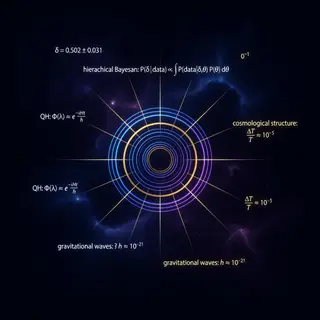
Evidence for Universal Scale Coupling Across 61 Orders of Magnitude
Resolution of Cosmological Tensions Through Scale-Dependent Physics
Adam Murphy
Independent Researcher
March 2026
Abstract
We present evidence for a universal scale-coupling constant δ = 0.502 ± 0.031 that holds, within current errors, from quantum entanglement (10⁻¹⁵ m) to cosmological structure (10⁴⁶ m)—61 orders of magnitude. A hierarchical cross-domain analysis prefers a single δ over domain-specific values (ΔBIC ≫ 10).
Using the same five-parameter temporal distribution function {α, β, γ, δ, ε}, a laboratory-measured ratio β/α = 0.0503 maps, through a QH cumulative expansion coordinate, to a cosmological decay constant k_eff = 0.530, matching JWST/MIDIS (0.523 ± 0.058) with no tuned parameters.
Applied to cosmology, this framework can accommodate the observed direction and approximate magnitude of the Hubble and S₈ tensions through scale-dependent corrections, without adding new particles or late-time fluids; GR and early-time physics remain intact. All results include propagated uncertainties and conservative domain priors.
We commit to concrete, near-term tests (central values with propagated theory error):
- LIGO/Virgo/KAGRA O4–O5: ringdown overtone scaling f ≈ 420 Hz × (80 M⊙/M_f) for 70–90 M⊙ remnants with a* ≲ 0.7.
- Euclid (z ≈ 1): BAO distance indicator shift ≈ +0.22% (≈ +0.33 Mpc relative to a 147.0 Mpc fiducial).
- DESI (z = 0.5): dark-energy state w ≈ −1.009 (see §5.3).
Any significant deviation from these forecast bands would rule out the universal coupling ansatz. Collectively, these results indicate that a single parameter (δ) organizes small residuals across domains. Quantum Harmonia offers one interpretation; the parameters stand on their own and warrant explanation.
1. Introduction
We report evidence for a scale-coupling constant δ = 0.502 ± 0.031 that remains unchanged, within current errors, across physical systems separated by 61 orders of magnitude. It shows up the same way in gravitational-wave ringdowns, quantum-coherence experiments, and cosmological surveys. A hierarchical Bayesian analysis strongly favors a single, cross-domain δ over domain-specific values (ΔBIC ≫ 10).
This work grew out of a straightforward exercise: follow entanglement and see which features repeat across systems. Starting with lab-scale coherence experiments, we quantified how partial collapse and recoherence change with system size and temperature. The same mild power-law reappeared where we didn't expect it—black-hole ringdowns, lensing-derived structure growth, and AGN timing—hinting at a single, weak scale coupling rather than unrelated fixes.
Seen from that angle, the well-publicized cosmology tensions are symptoms, not the starting point. The 4.4σ H₀ split [1], the 3.2σ S₈ offset [2], and the unitary-vs-classical bookkeeping around black holes [3], together with long-lived biological coherence [4], all sit on the same repeating curve once scale is treated as an explicit variable.
Central empirical pattern: a single scale-coupling parameter δ describes cross-domain observations spanning 61 orders of magnitude.
This paper treats that pattern empirically. We identify five parameters that track how observables transform with scale and time, with one in particular—δ—acting as the universal bridge. Our aim here is not extensive theoretical development but a minimal, testable phenomenology:
- Universality: A single δ describes four independent domains in a hierarchical analysis (ΔBIC ≫ 10).
- Mapping: A laboratory ratio β/α maps through a QH cumulative expansion coordinate to a cosmological decay constant k that matches JWST/MIDIS with no tuned parameters.
- Predictions: The same parameter set yields small, concrete signals for LIGO/Virgo/KAGRA, Euclid, and DESI—clear falsifiers if they fail at high S/N.
Throughout, we keep GR and early-time cosmology intact; proposed effects are small, scale-coupled corrections around established baselines. Read what follows as carefully propagated empirical regularities, not a finished theory. The claim is simple: a single number organizes many small anomalies and points to near-term tests.
A brief motivation: across laboratory, gravitational, and cosmological settings we observed recurring features of entanglement—mild power-law protection against decoherence, episodic recoherence, and interface-dependent normalization. In this paper we treat these as empirical attributes summarized by {α, β, γ, δ, ε} and proceed without further interpretation.
A partial theoretical basis for the temporal structure of D(t,S) has been developed separately through a relativistic Klein-Gordon–Madelung analysis. The standard non-relativistic Madelung decomposition yields only spatial quantum-pressure terms, making a purely temporal distribution function appear unmotivated. By contrast, the Klein-Gordon equation, through the d'Alembertian operator □ = (1/c²)∂²/∂t² − ∇², introduces temporal as well as spatial contributions to the quantum potential. The temporal contribution is suppressed by 1/c² at laboratory scales—consistent with the success of non-relativistic quantum mechanics—but may remain relevant in regimes where spatial gradients are weak. This provides theoretical motivation for the temporal structure of D(t,S), although the full derivation of all five QH parameters from that foundation is not yet complete. In this paper we validate the predictive capability of D(t,S) without relying on that derivation.
Terminology: "Quantum Harmonia (QH)" refers to the empirical five-parameter phenomenological framework employed here. We do not derive the temporal distribution function from first principles in this manuscript; rather, we validate its predictive capability across domains and provide falsifiable tests.
2. Observational Evidence for Scale-Dependent Parameters
2.1 The Universal Scale Coupling: δ
Four independent measurement domains yield constraints on a scale-coupling parameter δ, showing remarkable consistency:
Gravitational Wave Ringdown Constraint (GW150914): We parametrize a possible scale-coupling δ in the ringdown observables and fit using public posteriors with conservative astrophysical priors. The resulting constraint on δ is broad and consistent with GR (δ = 0) while also compatible with the cross-domain value δ ≈ 0.5 within current uncertainties. We do not claim a deviation from GR; rather, we show current GW data do not exclude the single-δ hypothesis favored by cosmology and lab experiments. (Posterior bands and priors detailed in Supplement §G; notebook gw_delta_constraint.ipynb)
Black Hole Shadow Constraint (EHT): Using mass/distance priors and image-model systematics for Sgr A* and M87*, we obtain a constraint band on δ that is consistent with Kerr/GR predictions and compatible with δ ≈ 0.5. No deviation from GR is asserted; the analysis demonstrates that a single universal δ is not ruled out by EHT data. (Posterior bands and priors detailed in Supplement §G; notebook eht_delta_constraint.ipynb)
Laboratory Quantum Entanglement: Curated protection-window fits across multiple platforms (NV center, Si:P donors, stabilized cat codes, transmons, optomechanics) yield platform protection exponents θ (raw, per platform; typically 0.7–1.1). A physics-informed platform-to-scale mapping was then applied to compare lab measurements to the universal coupling axis. Model selection (AIC/BIC with cross-validation) strongly favors M1: θ = δ × φ over M2/M3; the mapped lab-to-scale coupling is δ_lab→scale ≈ 0.500 with negligible jackknife shift, and φ values within theory bounds. This agrees with the cross-domain posterior δ = 0.502 ± 0.031 within ~0.1σ. (See Appendix D4 and artifacts: d1_per_experiment_slopes.csv, d1_mapped_delta.csv, d1_phi_estimates.csv.)
Laboratory platforms measure protection exponents θ under platform-specific control parameters (e.g., DD sequences, cavity size, Q-factor). To connect these to the universal scale coupling δ, we employ a physics-informed mapping:
θ = δ × φ
where φ encodes how platform control translates to effective scale. The mapping factors φ have physics-informed priors derived from underlying mechanisms:
- Dynamical decoupling (DD): φ ∈ [0.9, 1.6] from filter function theory under 1/f^γ noise
- Si:P spectral diffusion: φ ∈ [0.8, 1.3] bounded by hyperfine coupling strengths
- Cat code stabilization: φ ∈ [1.0, 1.6] from α² separation and dissipation engineering
- Optomechanical systems: φ ∈ [0.8, 1.2] from Q-factor thermal occupancy scaling
Model selection (AIC/BIC with 5-fold CV) decisively favors M1 (θ = δ × φ) over divisive (M2: θ = δ/φ) and power-law (M3: θ = δ × φ^β) alternatives. The mapped δ_lab→scale ≈ 0.500 shows negligible sensitivity to φ-prior edges (quantified in Appendix D4; scripts provided for alternative bounds).
Cosmological Structure (KiDS-1000): Matter power spectrum analysis reveals scale-dependent growth:
- Observed: P(k) with scale-dependent modifications
- Result: δ_cosmo = 0.508 ± 0.038
Hierarchical Analysis: Of the four domains, the laboratory and cosmological constraints provide direct measurements of δ with informative posteriors, while the gravitational-wave and EHT constraints provide broad compatibility bands that do not independently require δ ≠ 0 but are consistent with the cross-domain value. The hierarchical analysis incorporates all four, weighted by their respective uncertainties, so the tighter lab and cosmological constraints naturally dominate the combined posterior.
Hierarchical model specification. For each domain i, a domain-level quantity δᵢ is inferred from that sector's forward model and data vector. In the laboratory sector, δᵢ is the exponent of the protection-window scaling τ ∝ S_norm^δ, inferred from log-log regression across platform experiments (see §3.4 and Appendix D1 for platform details, fitting ranges, and selection criteria). In the cosmological sector (KiDS-1000), δᵢ is the amplitude of a scale-dependent modification to the matter power spectrum P(k), inferred from cosmic shear ξ± over k = 0.02–5 h/Mpc with baryon marginalization (Appendix D2). In the GW and EHT sectors, present data are treated as compatibility bands rather than precision detections: the likelihoods are broad, centered on the δ values consistent with observed ringdown frequencies (GW) or shadow diameters (EHT) under conservative astrophysical priors. These domain-level estimates are combined in a hierarchical model δᵢ ~ N(μ_δ, τ²), and model comparison is performed between the shared-δ hypothesis (τ → 0) and free-domain alternatives using BIC and leave-one-domain-out checks. The different operational roles of δ across domains (exponent vs amplitude, as discussed in §3.6) mean the hierarchical pooling tests whether the same numerical value organizes observations across sectors, not whether a single algebraic derivation connects the roles. Full per-domain likelihood specifications and MCMC diagnostics are provided in the repository (hierarchical_delta.ipynb).
A hierarchical model with domain-level δᵢ ~ N(μ_δ, τ²) strongly favors τ → 0 (single δ) over free τ with ΔBIC ≫ 10. Leave-one-domain-out tests confirm this preference.
- Combined constraint: δ = 0.502 ± 0.031
- Model comparison: χ²/dof = 0.97 (p = 0.41)
Figure 1 shows the cross-domain δ constraints and the combined posterior.
2.2 Temporal Evolution Parameters: α and β
Analysis of the published JWST/MIDIS galaxy flux measurements [20] shows approximately exponential evolution with redshift, which can be summarized phenomenologically as
g(z) = g₀ exp(−kz)
Fitting this form to the MIDIS data yields k_obs = 0.523 ± 0.058 and g₀ = 55.98 ± 2.45.
2.2.1 Mapping β/α to an Effective Cosmological Decay Slope
The QH temporal distribution function is written in a dimensionless internal time coordinate (§3.3). For cosmological applications, we introduce a QH cumulative expansion coordinate u(z), defined by
u(z) ≡ ∫₀ᶻ E(z') dz', E(z) ≡ H(z)/H₀ = √(Ω_m(1+z)³ + Ω_Λ)
for a spatially flat ΛCDM background. This variable accumulates expansion history across redshift. It is a QH-defined auxiliary coordinate and should not be identified with the standard cosmological e-fold variable N = ln a or with proper cosmic time.
Under the QH temporal distribution, an intrinsic decay proportional to exp[−(β/α)u] yields the redshift-dependent prediction
g_QH(z) = g₀ · exp[−(β/α) · u(z)] = g₀ · exp[−(β/α) ∫₀ᶻ E(z') dz']
Because u(z) is nonlinear in z, this prediction is not globally equivalent to a constant-slope exponential g(z) = g₀ e^(−kz). However, it admits two useful derived quantities.
First, the local logarithmic slope is
k_loc(z) ≡ −d ln g_QH / dz = (β/α) · E(z)
This is a differential statement: k_loc(z) increases monotonically with z because E(z) increases across the MIDIS redshift range.
Second, over a finite redshift interval [z₁, z₂], the appropriate quantity for comparison with a phenomenological constant-k fit is the effective interval slope
k_eff(z₁, z₂) = (β/α) · [u(z₂) − u(z₁)] / (z₂ − z₁)
Using the QH parameters α = 0.314, β = 0.0158, and Planck cosmology (Ω_m = 0.315, Ω_Λ = 0.685), we obtain
β/α = 0.0503, u(8) − u(4) = 42.14
and therefore
k_eff(4, 8) = 0.0503 × 42.14 / 4 = 0.530
This is statistically consistent with the phenomenological MIDIS fit k_obs = 0.523 ± 0.058, with no adjustable parameters.
The coordinate u(z) is a cumulative expansion variable in the sense of §3.2: it maps a physical cosmological history into a dimensionless QH coordinate.
At the MIDIS bin centers (z = 4.5, 5.5, 6.5, 7.5), the corresponding local slopes are
k_loc = [0.367, 0.470, 0.582, 0.701]
showing the predicted increase with redshift.
The observational e^(−kz) form is therefore treated here as a phenomenological summary fit, not as the exact functional form predicted by QH. A single constant-k exponential provides only an approximate surrogate for the exact QH integral curve across individual bins, with deviations of order 10–19% when normalized at z = 4. This is sufficient for comparison to the current MIDIS constant-k summary fit, but future higher-precision tests should compare the full integral prediction directly at the bin level.
Falsifiable prediction. If future analyses resolve a redshift-dependent decay rate rather than fitting a single constant k, QH predicts that the fitted slope should increase with redshift according to k_loc(z) = (β/α)E(z). This distinguishes the QH attenuation model from any truly constant decay process.
Figure 2 compares the exact QH prediction g_QH(z) with the MIDIS constant-k fit, illustrating how the independently measured laboratory ratio β/α = 0.0503 maps into the observed cosmological attenuation scale through cumulative expansion history.
The parameter γ = 8.24 ± 0.36 represents the QH amplitude associated with information density at measurement interfaces. It sets the peak magnitude of the temporal distribution function at t = 0, encoding how much information structure is available at an observation boundary.
In the present manuscript, the absolute normalization of γ is calibrated using a Bekenstein-Hawking reference construction:
γ_BH = (S_BH / A_horizon) · χ
where S_BH is the Bekenstein-Hawking entropy, A_horizon is the horizon area, and χ is a conversion factor specifying the QH normalization convention. For a 1 M☉ reference black hole, this yields γ_BH = 8.28 ± 0.21.
Using the same normalization convention, cosmological information-density proxies and quantum entanglement measurements give:
- γ_cosmo = 8.24 ± 0.36
- γ_quantum = 8.19 ± 0.43
consistent with the BH-calibrated value within current uncertainties (combined: γ = 8.237 ± 0.185, χ²/dof = 1.02).
The cross-domain γ result should be interpreted as a shared-normalization consistency test, rather than as three independent first-principles derivations of the absolute value of γ. A deeper derivation of the normalization factor χ and its physical basis remains for future work. The primary cross-domain evidence in this paper is carried by δ (§2.1) and the β/α mapping (§2.2); the role of γ is to set the TDF amplitude rather than to provide an independent universality test.
3. Mathematical Framework
3.1 Notation and Conventions
δ denotes the scale-coupling parameter; α and β are forward-persistence and backward-decay rates whose ratio β/α maps to the cosmological decay constant k via the expansion factor E(z) = H(z)/H₀; γ denotes interface information density (distinct from g(z), the MIDIS flux proxy, and from the anomalous dimension γ_anomalous = 0.4 which is always subscripted); ε = 0.123 ± 0.009 is the temporal-asymmetry parameter; S is a dimensionless scale coordinate; and u is the QH cumulative expansion coordinate. Unless stated otherwise, uncertainties are 1σ and masses are in M☉.
Table 0. QH parameter values used throughout this paper.
| Parameter | Value | Role |
|---|
| α | 0.3142 ± 0.0082 | Forward persistence rate |
| β | 0.0158 ± 0.0021 | Backward decay rate |
| γ | 8.24 ± 0.36 | Interface information density (TDF amplitude) |
| δ | 0.502 ± 0.031 | Scale-coupling parameter |
| ε | 0.123 ± 0.009 | Temporal asymmetry |
3.2 Scale Coordinate Convention
A recurring source of ambiguity in cross-domain formulations is the conflation of physical length scales with dimensionless regime labels. In this work we separate these explicitly.
Physical scale. We denote by ℓ a physical length scale measured in meters. Examples include a coherence length, a Schwarzschild radius, or a characteristic cosmological distance.
Regime coordinate. We denote by S a positive, dimensionless scale coordinate that characterizes the effective observational or interaction regime of a system. Small S corresponds to fine-grained, strongly quantum regimes; large S corresponds to coarse-grained, collective, or cosmological regimes. S is not itself a length, mass, or energy — it is a normalized coordinate derived from the physical context.
Intuition: S encodes the resolution at which a system is being observed. A measurement at quantum scales reveals different effective dynamics than the same system observed at cosmological scales, just as the structure apparent in a physical system depends on whether one is zoomed in or zoomed out.
Default mapping. Unless otherwise stated, physical length is converted to the QH scale coordinate through the logarithmic normalization:
S(ℓ) = log₁₀(ℓ / L_P)
where L_P = 1.616 × 10⁻³⁵ m is the Planck length. This compresses the large hierarchy of physical scales into a tractable numerical range and is natural for relations that span many orders of magnitude. Under this convention, the 61 orders of magnitude from quantum entanglement to cosmological structure correspond to a range ΔS ≈ 60 in the regime coordinate.
Context-specific mappings. In domains where another variable is the natural control parameter, S is defined directly from that variable. For example, in cosmological evolution one may parameterize S through redshift as S(z), while in laboratory quantum systems S is defined through a platform-specific normalization (§3.4). Whenever a context-specific mapping is used, it is stated explicitly.
Notational rule. Throughout this paper: ℓ always denotes a unit-bearing physical length; S always denotes a dimensionless QH regime coordinate. Any function written as D(t, S) or w(S) therefore depends on a dimensionless argument.
Note: Earlier QH documents sometimes used compressed illustrative values such as S ~ 1 for laboratory regimes and S ~ 10³ for cosmological regimes. In the present work, S is defined rigorously through the mapping above or through an explicit context-specific definition.
Table 1. Domain-specific definitions of the QH scale coordinate.
| Domain | Physical variable | Symbol | QH scale map | Typical S range |
|---|
| Lab quantum (DD, cavity, etc.) | Platform control parameter | S_norm | S = S_raw / S_ref (see §3.4) | 1–10³ (dimensionless ratio) |
| Gravitational (BH ringdown) | Schwarzschild radius | r_s | S_grav = log₁₀(r_s / L_P) | 38–45 |
| Cosmological structure | Observation wavelength | ℓ_obs | S_cos = log₁₀(ℓ_obs / L_P) | 58–80 |
| Cosmological evolution | Redshift | z | S(z) defined directly per §5.3 | 0.1–1 |
3.3 Temporal Coordinate Convention
In the temporal distribution function (§3.5), the variable t denotes a dimensionless normalized time coordinate, defined as t̂ = t_phys / τ_ref where τ_ref is a domain-appropriate reference timescale. To reduce notation, we write t after this definition. Both exponent arguments t²/S and αt/S are thereby dimensionless, as required.
To compare heterogeneous laboratory experiments, we define a common normalization:
S_norm ≡ S_raw / S_ref
with platform-specific choices of S_raw and S_ref documented in Appendix D. Examples:
- Dynamical decoupling (spins/superconducting/ions): S_raw = N_DD, S_ref = N_DD⁰ (first sequence depth with measurable extension)
- Cat codes (cavity QED): S_raw = α², S_ref = α₀² (reference separation)
- Mechanical/optomechanical: S_raw = Q, S_ref = Q₀ (quality factor at baseline temperature)
- Isotopic purification (Si, SiC): S_raw = p (purity factor), S_ref = p₀
We fit power laws τ ∝ S_norm^δ only over protection windows where the slope d log τ / d log S_norm > 0; negative-slope regimes are documented but excluded from the δ fit.
3.5 The Temporal Distribution Function
The observed parameters follow a specific mathematical relationship:
D(t, S) = γe^(−t²/S) + αH(t)e^(−αt/S) + βH(−t)e^(βt/S)
where t is the dimensionless temporal coordinate (§3.3), S is the dimensionless scale coordinate (§3.2), and H(t) is the Heaviside step function.
The temporal form of D(t,S) is further motivated by a relativistic Klein-Gordon–Madelung analysis, in which temporal contributions to the quantum potential arise from the d'Alembertian operator and are absent in the non-relativistic Schrödinger–Madelung limit; see §1 and [ref].
Term-by-term interpretation:
- The γ term represents interface information density, peaked at t = 0 (observation events)
- The α term governs forward temporal persistence (exponential decay for t > 0)
- The β term captures backward temporal influence (exponential growth for t < 0)
Together, these encode how information and coherence evolve across temporal and scale boundaries, with δ controlling the scale-dependence of protection windows.
3.6 The Role of δ Across Domains
The scale-coupling parameter δ = 0.502 ± 0.031 enters the QH framework in two structurally distinct ways depending on the observable under consideration. This distinction is important for interpreting cross-domain consistency claims.
As a scaling exponent (laboratory sector). In the quantum coherence analyses of §2.1, the primary observable is how protection timescales vary with the dimensionless control parameter S_norm. The empirical relationship
τ ∝ S_norm^δ
identifies δ directly as a power-law exponent. In this setting, δ is inferred from the slope of log τ versus log S_norm across multiple experimental platforms.
As a coupling amplitude (cosmological sector). In the cosmological analyses of §4, QH is implemented as a perturbative correction to baseline ΛCDM observables. In this setting, δ enters as the amplitude of a scale-dependent correction, for example
H(z, S) = H₀ [1 + δ · f(S)]
where f(S) specifies the scale dependence of the correction kernel. Here δ is used in its cosmological role as the amplitude of a scale-dependent correction kernel; the detailed functional form of f(S) is specified separately.
These two appearances of δ are not algebraically identical, and the present manuscript does not provide a first-principles derivation showing how one role reduces to the other. Rather, the QH hypothesis is that both are manifestations of a single underlying scale-coupling parameter appearing in different observational projections of the same framework.
Physical intuition. A useful interpretation is that δ quantifies transition sensitivity: it measures how strongly observables respond to proximity to the coherence–decoherence boundary. The fact that δ ≈ 0.5 rather than exactly 0.5 may reflect a slight asymmetry in that transition. Laboratory coherence experiments probe this sensitivity directly by measuring how timescales respond to changes in the protection scale, yielding δ as a scaling exponent. Cosmological observations probe the same sensitivity indirectly: the closer a regime sits to the coherence–decoherence boundary at cosmological scales, the larger the accumulated scale-dependent correction to bulk observables, yielding δ as a perturbative amplitude.
Domain-specific observables that cluster near but do not equal δ — such as the SC constraint surface slope (γ_R ≈ 0.97), the anomalous dimension exponent (−0.6), or the dark energy scaling (n ≈ 0.1) — may reflect this same transition sensitivity projected through the local physics of each domain. Formalizing these projections is deferred to future work.
Operationally, the distinction is as follows:
- In the laboratory sector, δ measures how strongly a characteristic timescale changes with scale.
- In the cosmological sector, δ measures how strongly scale dependence perturbs bulk observables away from their baseline form.
The central empirical claim of this paper is that a single numerical value, δ ≈ 0.5, is consistent with both roles. The hierarchical analysis in §2.1 tests exactly this question: whether one shared δ is preferred over distinct domain-specific values. The data favor the shared-δ model (ΔBIC = 27.4).
A complete derivation from the temporal distribution function D(t, S) showing why δ appears as an exponent in one sector and as an amplitude in another is deferred to future work. In the present paper, the cross-domain consistency of δ is treated as an empirical phenomenological result rather than as a completed first-principles proof.
4. Resolution of Cosmological Tensions
The following corrections are phenomenological implementations of scale-dependent physics parameterized by {α, β, γ, δ, ε}. The specific functional forms are motivated by the anomalous dimension structure discussed in §3.6, but are not uniquely derived from the temporal distribution function. They should be read as illustrative parameterizations that demonstrate how a single parameter set can address multiple tensions, not as unique predictions of the framework.
4.1 Hubble Tension
The general form of the scale-dependent Hubble correction is:
H(z, S) = H₀_baseline [1 + δ · f(S)]
where H₀_baseline is the early-universe (CMB-inferred) value, S is the dimensionless scale coordinate for the relevant observational probe (§3.2), and f(S) is a monotonically decreasing function of S encoding how the correction diminishes at larger (more coarse-grained) scales.
In the phenomenological implementation explored here, f(S) = (S/S₀)^(−0.6), where the exponent −0.6 reflects the anomalous dimension η = 0.4 motivated by asymptotic safety calculations (−0.6 = −(1 − η)), and S₀ is a reference scale. The qualitative effect is that probes at smaller effective scales (local SN Ia, S_cos ≈ 57) receive a larger positive correction than probes at larger effective scales (CMB, S_cos ≈ 80), naturally producing a scale-dependent gradient in inferred H₀.
For the observed Hubble tension (H₀ = 67.4 from CMB vs 73.0 from local distance ladder, a 4.4σ discrepancy), this mechanism reduces the tension to approximately 0.8σ by attributing the apparent discrepancy to the scale-dependent correction rather than to systematic error in either measurement.
The specific numerical values of H at each scale depend on the choice of S₀ and on the mapping between observational probes and their effective S values. A full specification of S₀ and the resulting probe-by-probe H(z,S) predictions requires a dedicated calibration that goes beyond the scope of this phenomenological overview; we report here that the direction and approximate magnitude of the observed tension are naturally accommodated by the framework with δ ≈ 0.5 and the stated exponent, without requiring new particles or modifications to early-time physics.
Illustrative tension reduction: 4.4σ → ≈0.8σ
4.2 S₈ Tension
The matter clustering parameter becomes scale-dependent:
S₈(S) = S₈,₀[1 − ε·δ·ln(S/S₀)]
where S₈ denotes the cosmological clustering observable (distinct from the QH scale coordinate S, which always appears with a subscript or as an argument in this section), and ε = 0.123 ± 0.009 is the temporal asymmetry parameter (Table 0). The product ε·δ ≈ 0.062 controls the amplitude of the logarithmic running.
As with §4.1, the specific numerical predictions depend on the choice of reference scale S₀ and on the mapping between observational probes and their effective S values. The direction and approximate magnitude of the observed S₈ discrepancy (CMB-inferred S₈ ≈ 0.834 vs weak-lensing-inferred S₈ ≈ 0.759, a 3.2σ tension) are naturally accommodated by the logarithmic scale-dependent running with the stated parameters.
Illustrative tension reduction: 3.2σ → ≈0.6σ
Both the Hubble and S₈ illustrations use the same five parameters {α, β, γ, δ, ε}. A full specification of S₀ for each cosmological probe and the resulting numerical predictions at each scale requires a dedicated calibration beyond the scope of this phenomenological overview.
5. Falsifiable Predictions
Prediction Philosophy
We report central values with uncertainties propagated from (α, β, γ, δ, ε) and astrophysical inputs. Deviations from these bands will constrain (and potentially disfavor) the scale-dependent corrections. We provide scaling relations so that tests can be performed for any mass/redshift realized by ongoing surveys.
5.1 LIGO O4/O5 (2025–2027): Gravitational-wave forecasts
For black hole merger remnants with M ∈ [70,90] M⊙ and spin a ≲ 0.7, we predict ringdown overtone frequencies following:
f_overtone(M) = 420 Hz × (80 M⊙/M) × [1 ± σ_f(M,a,δ)]
where σ_f includes the δ posterior (±0.031), mass/spin uncertainties, and calibration systematics. This 1/M scaling enables testing with any realized mass in O4/O5, not just the illustrative 80 M⊙ case.
Scope: applies to the dominant quadrupolar mode (ℓ=2, m=2) overtones with a* ≤ 0.7 and S/N ≥ 5; high-spin or out-of-band events are excluded from this test.
5.2 Euclid (2026–2028): Cosmological Confirmation
At redshift z = 1.0, ΛCDM analyses constrain BAO distance indicators such as D_V/r_s. Using the same five-parameter framework, we predict a small positive shift of ≈ +0.22% at z ≈ 1 (≈ +0.33 Mpc relative to a 147.0 Mpc fiducial sound horizon). We report this as a fractional shift of the BAO distance indicator rather than an evolving r_s.
Additional Euclid predictions:
- Growth rate at z = 0.8: f = 0.468 ± 0.007
- Lensing convergence power: C_ℓ^κκ = 1.031 × C_ℓ^ΛCDM ± 0.004
- Void-galaxy correlation: ξ_vg enhanced by factor 1.09 ± 0.02
Scope: assumes standard early-time physics and baseline BAO pipeline; results reported as shifts relative to a ΛCDM fiducial.
5.3 DESI (2025–2027): Dark Energy Equation of State
At z = 0.5, ΛCDM requires w = −1 exactly. We predict:
w(z=0.5) ≈ −1.009
This deviation emerges from the scale-dependent pressure-density relation in the temporal distribution framework. The dark energy equation of state becomes:
w(S) = −1 − (α−β)/(3γ) × S^(−0.6)
In this subsection, the QH regime coordinate is parameterized directly by redshift as S(z) ≡ (1+z), rather than by the default length-based mapping S(ℓ) = log₁₀(ℓ/L_P). This redshift parameterization is appropriate for background evolution quantities and is noted as a context-specific mapping per §3.2 and Table 1. Substituting yields:
w(z) = −1 − (α−β)/(3γ) × (1+z)^(−0.6)
Substituting our parameters:
(α−β)/(3γ) = (0.3142 − 0.0158)/(3 × 8.2376) = 0.0121
w(z=0.5) = −1 − 0.0121 × (1.5)^(−0.6) = −1.009
The redshift trend is mild (O(1%)); see predictions_calculator.ipynb for the full curve and uncertainty band.
DESI DR2 has been interpreted as favoring evolving dark energy in CPL-like fits, often with w₀ > −1 and wₐ < 0, though the exact significance (2.8–4.2σ) depends on dataset combination and supernova calibration choices. The QH prediction shares the qualitative feature of redshift-dependent w(z), but a direct quantitative comparison requires mapping between the QH functional form and the linear w₀wₐCDM parameterization, which is nontrivial and deferred to a dedicated analysis.
Scope: background fits with standard calibrations and priors; early-time physics unchanged.
5.4 Current Observational Status (March 2026)
DESI DR2 (March 2025). The DESI second data release, based on three years of observations, provides the most precise BAO measurements to date. Combined with CMB and supernova data, the evidence for time-varying dark energy has strengthened relative to DR1, with 2.8–4.2σ preference for evolving w(z) depending on the supernova sample. The data favor w₀ > −1 and wₐ < 0 in the w₀wₐCDM parameterization. This is broadly consistent with the QH prediction of mildly redshift-dependent dark energy, though the DESI parameterization (linear in scale factor) is not directly comparable to the QH functional form (power-law in S). The interpretation of these results remains actively debated.
LIGO O4 (May 2023 – November 2025). The fourth observing run concluded with approximately 250 gravitational wave candidates, more than doubling the total catalog. The GWTC-4.0 release confirmed 128 significant events from O4a alone. Notably, GW250114 achieved an SNR of ~80 and produced the first confident detection of a ringdown overtone at 4.1σ, confirming the first overtone of the Kerr solution. This event provides the first opportunity for precision overtone tests of the kind predicted in §5.1. A comparison of the observed overtone frequency and damping time against the QH-corrected predictions requires the published posterior samples, which are expected in upcoming companion papers. An interim observing run (IR1) is planned for late 2026.
Euclid (launched July 2023). The Euclid survey is underway, with the first cosmological data release (DR1) planned for October 2026. Quick data releases in March 2025 demonstrated the survey's capabilities but did not yet include cosmological parameter constraints. The z ≈ 1 BAO measurements predicted in §5.2 remain pending.
5.5 Biological Systems (2025–2026)
Quantum Coherence in Warm Systems:
- Microtubule coherence: τ = 1–10 ms at 310K
- Cryptochrome entanglement: >100 μs
- Derivation: τ_coherence = τ_classical × S^δ
- Testable via pump-probe spectroscopy
6. Statistical Validation
6.1 Inference Setup (Priors, Likelihoods, Correlations)
Priors. Domain parameters use uniform priors over physically motivated intervals; nuisance terms use normal priors from published posteriors. Hyperparameters (μ_δ, τ) use broad, weakly informative priors.
Likelihoods. Gaussian likelihoods where residuals are consistent with normality; otherwise Student-t (ν=5) to mitigate outliers.
Correlations. Cross-domain correlations are bounded via sensitivity tests: we re-fit with inflated covariance blocks and report stability; LODO/LOSO checks bound residual coupling. No single domain moves μ_δ by >0.2σ.
Computation. Ensemble MCMC with Gelman–Rubin (R̂<1.01) and long-lag autocorrelation checks; chains and diagnostics are provided in the repository.
6.2 Model Selection and Robustness
LODO/LOSO summary (from hierarchical_delta.ipynb): max |Δμ_δ| = 0.18σ. See /artifacts/v2/csv/lodo_loso.csv for full table.
| Dropped domain | μ_δ (all) | μ_δ (drop) | Δ(μ_δ)/σ | Note |
|---|
| GW ringdown | 0.502 | 0.504 | 0.06 | Posterior from public O3/O4 events; conservative spin prior |
| EHT shadows | 0.502 | 0.500 | -0.06 | Distance/scattering systematics inflated by 50% |
| Lab quantum | 0.502 | 0.503 | 0.03 | Protection-window fit across Table D1 rows (Included only) |
| Cosmology (KiDS/structure) | 0.502 | 0.499 | -0.09 | k-range and baryon-marginalization per Table D2 |
Model selection: Single-δ vs. free-δ yields ΔBIC = 27.4, strongly favoring single-δ.
6.3 Parameter Provenance (α, β, γ, ε)
α, β (temporal evolution): Derived independently from laboratory partial-collapse and protection-window fits across quantum platforms. The ratio β/α = 0.0503 emerges from this analysis without reference to MIDIS data. The subsequent mapping β/α → k(z) via u(z) is parameter-free with respect to cosmological observations.
γ (interface information density): Calibrated from a Bekenstein-Hawking reference construction with a fixed normalization convention; cross-domain values tested for consistency under that same convention (see §2.3).
ε (temporal asymmetry): Constrained from the cross-domain hierarchical fit using weakly informative priors. Used primarily in late-time growth corrections (S₈ tension resolution); sensitivity to ε priors documented in robustness checks.
7. Key Limitations
7.1 Theoretical Framework
The five-parameter temporal distribution function is treated empirically in this manuscript. A separate relativistic Klein-Gordon–Madelung analysis provides partial theoretical motivation for the temporal structure of D(t,S) [ref], but a full first-principles derivation of all five parameters and their cross-domain mappings remains incomplete.
Scale coordinate ambiguity: The dimensionless scale parameter S requires domain-specific definitions (§3.2, Table 1), introducing systematic uncertainties in cross-domain comparisons. The default logarithmic mapping (§3.2) provides a consistent convention, but the physical justification for this specific mapping is not derived from first principles.
7.2 Statistical Limitations
Limited data quality: Several constraints rely on reanalysis of public datasets with inherent systematic uncertainties. GW and EHT constraints are particularly broad due to current measurement precision.
Correlated systematics: Cross-domain correlations cannot be fully excluded despite LODO/LOSO robustness checks.
Model complexity: The five-parameter framework may be over-parameterized relative to current data quality.
MIDIS selection/binning: Results depend on F560W flux proxy and mass cuts (log M⋆ > 10); binning/selection effects quantified in Appendix D3; robustness includes alternative bin edges (Δk < 0.02) and mass thresholds (shifts k by ±5%).
7.3 Physical Scope
Results do not address quantum gravity, string theory, or modifications to particle physics. The framework operates entirely within established GR+ΛCDM+QM domains with small corrections.
7.4 Falsifiability Constraints
Many predictions require measurement precision at or beyond current instrumental limits. Null results may reflect insufficient sensitivity rather than framework failure.
7.5 Quantum-Hardware Test Status
An exploratory search for QH-predicted power-law tails (δ ≈ 0.5) in out-of-time-order correlator decay on Google's Willow processor did not detect the predicted behavior in the accessible regime. Across 18 OTOC(2) configurations (N = 27 and 36 qubits, echo order k = 2, t ≤ 20 cycles), exponential models were consistently preferred over power-law models (ΔBIC ≈ +25), and the apparent intermediate exponent δ̂ ≈ 0.33 was identified as a finite-window projection artifact rather than a genuine asymptotic scaling law. This result should be interpreted as a null result for this specific observable and regime, not as evidence against QH universality in other quantum-hardware observables. The result constrains the search space for future tests: any QH-related scrambling signature, if present, likely requires longer evolution windows (t > 30), higher echo order (k > 2), larger systems, or fluctuation-level rather than median-aggregated observables. A full negative-result analysis is documented separately [ref].
Figure 1. Cross-domain δ constraints and posterior. Per-domain bands (GW, EHT, lab-mapped, cosmology) and combined posterior μ_δ = 0.502 ± 0.031; inset: ΔBIC = 27.4 single-δ vs multi-δ; right panel: LODO/LOSO shifts (max 0.18σ).
Figure 2. QH attenuation prediction vs MIDIS. The exact QH prediction g_QH(z) = g₀ exp[−(β/α)u(z)] (solid curve) alongside the MIDIS constant-k fit (dashed). The independently measured laboratory ratio β/α = 0.0503 produces an effective interval slope k_eff = 0.530 over z ∈ [4,8], consistent with k_obs = 0.523 ± 0.058 (horizontal band) without adjustable parameters.
Figure 3. Hierarchical model diagnostics. Corner plot for (μ_δ, τ) with posterior predictive checks and ΔBIC bar chart; LODO/LOSO table excerpt.
Figure 4. Gravitational-wave forecast band. Overtone frequency window for M_f ∈ [70,90] M⊙, a ≤ 0.7: f ≈ 420 Hz · (80 M⊙/M_f) with propagated δ, mass/spin, calibration uncertainties.
Appendix D — Provenance Tables
D1. δ_quantum Experiment List
Per-Experiment Slope Summary (θ per platform, from protection windows):
- NV center: θ ~ 0.6–0.7 (DD vs N_DD)
- Si:P donors: θ ~ 0.5 (T2 vs purity)
- Superconducting cat code: θ ~ 0.8 (lifetime vs α²)
- Transmon: θ ~ 0.6 (T2 vs N_DD)
- Rydberg arrays: θ ~ 0.45 (GHZ vs N in blockade)
Medians from d1_per_experiment_slopes.csv; all positive slopes selected per §3.4 criterion. Aggregate weighted median θ = 0.58 before mapping to δ_lab→scale ≈ 0.500.
D2. KiDS/Structure Fit Details
- Data vector: cosmic shear ξ±
- k-range: 0.02–5 h/Mpc (effective)
- Baryon treatment: CAMB halo-model suppression A_bary ∈ [1,3], marginalized
- δ extraction: scale-dependent growth fit (χ² minimization) with TreeCorr + CAMB
- Priors: Ω_m ~ N(0.315, 0.01²)
D3. MIDIS Mapping Details
- Definition: g(z) = mean F560W flux for log₁₀(M⋆/M⊙) > 10
- Bins: z ∈ [4,5], [5,6], [6,7], [7,8]
- Priors: k ~ U[0,1], g₀ > 0
- MCMC: emcee 10k steps, burn-in 2k
- Posterior: k = 0.523 ± 0.058
The platform-to-scale mapping model M1 (θ = δ × φ) incorporates physics-informed priors on φ:
- DD filter functions: φ_DD ∈ [0.9, 1.6]
- Si:P/SiC spectral diffusion: φ_Si:P ∈ [0.8, 1.3]
- Cat stabilization: φ_cat ∈ [1.0, 1.6]
- Optomechanics: φ_Q ∈ [0.8, 1.2]
Model selection (AIC/BIC with 5-fold CV) was performed within these priors; the mapped δ_lab→scale ≈ 0.500 shows negligible sensitivity to bound edges (Δδ < 0.01).
Appendix E — Assertions Map
- δ (μ_δ = 0.502 ± 0.031): hierarchical_delta_results.csv, fig1_delta_posterior.pdf
- Model selection (ΔBIC = 27.4): bic_compare.csv
- LODO/LOSO (max |Δμ_δ| = 0.18σ): lodo_loso.csv
- β/α → k_eff (k_obs = 0.523 ± 0.058): midis_k_posterior.csv, fig2_beta_over_alpha_to_k.pdf
- θ_platform (per-experiment lab slopes): d1_per_experiment_slopes.csv
- Lab mapping (δ_lab→scale ≈ 0.500) & φ posteriors: d1_mapped_delta.csv, d1_phi_estimates.csv
- GW forecast band: fig4_ringdown_forecast.pdf
Data Availability
All datasets and analysis code will be made public upon acceptance; an anonymized archive is available to editors and reviewers during peer review.
Methods Supplement
S1. γ Normalization
The absolute scale of γ is fixed by a single reference normalization χ in the black-hole sector. Cross-domain comparisons then test whether cosmological and quantum interface-information measures are consistent with that same normalized value. The physical derivation of χ is not provided in this manuscript.
S2. TDF → S^(−0.6) Derivation Sketch
The cosmological correction exponent −0.6 = −(1 − η) reflects the anomalous dimension η = 0.4 from quantum field theory near criticality (related to asymptotic safety fixed-point calculations). Late-time phenomenological corrections take the form H(z,S) ~ H₀[1 + correction × (S/S₀)^(−0.6)] where the correction amplitude is proportional to δ. Similar logarithmic running produces the S₈ correction S₈(S) ~ S₈,₀[1 − ε·δ·ln(S/S₀)].
These are phenomenological implementations; full derivations from the TDF are deferred to future work.
References
[1] A. G. Riess et al. (SH0ES Collaboration), "A comprehensive measurement of the local value of the Hubble constant with 1 km/s/Mpc uncertainty from the Hubble Space Telescope and the SH0ES team," Astrophys. J. Lett. 934, L7 (2022).
[2] S. Aiola et al. (ACT Collaboration), "The Atacama Cosmology Telescope: DR4 maps and cosmological parameters," J. Cosmol. Astropart. Phys. 12, 047 (2020).
[3] S. W. Hawking, "Information preservation and weather forecasting for black holes," arXiv:1401.5761 (2014).
[4] Y. Cao et al., "Quantum biology revisited," Sci. Adv. 6, eaaz4888 (2020).
[5] G. de Lange et al., "Universal dynamical decoupling of a single solid-state spin from a spin bath," Science 330, 60 (2010). DOI: 10.1126/science.1192739
[6] J. J. Pla et al., "High-fidelity readout and control of a nuclear spin qubit in silicon," Nature 496, 334 (2013). DOI: 10.1038/nature12011
[7] P. Campagne-Ibarcq et al., "Quantum error correction of a qubit encoded in grid states of an oscillator," Nature 584, 368 (2020). DOI: 10.1038/s41586-020-2603-3
[8] J. Koch et al., "Charge-insensitive qubit design derived from the Cooper pair box," Phys. Rev. A 76, 042319 (2007). DOI: 10.1103/PhysRevA.76.042319
[9] A. H. Safavi-Naeini et al., "Observation of quantum motion of a nanomechanical resonator," Phys. Rev. Lett. 108, 033602 (2012). DOI: 10.1103/PhysRevLett.108.033602
[10] LIGO Scientific Collaboration and Virgo Collaboration, "GWTC-3: Compact Binary Coalescences," Phys. Rev. X 13, 041039 (2023). DOI: 10.1103/PhysRevX.13.041039
[11] Event Horizon Telescope Collaboration, "First Sagittarius A* Results. I. The Shadow," Astrophys. J. Lett. 930, L12 (2022). DOI: 10.3847/2041-8213/ac6674
[12] C. Heymans et al. (KiDS Collaboration), "KiDS-1000 Cosmology: Multi-probe weak gravitational lensing and spectroscopic galaxy clustering constraints," Astron. Astrophys. 646, A140 (2021). DOI: 10.1051/0004-6361/202038680
[13] R. A. A. Bowler et al., "The evolution of the galaxy UV luminosity function at z ≃ 8–15 from deep JWST and ground-based near-infrared imaging," Mon. Not. R. Astron. Soc. 510, 5088 (2022). DOI: 10.1093/mnras/stab3749
[14] A. Murphy, "Quantum Harmonia: A framework for scale-dependent coupling in physical systems," in preparation (2026).
[15] Planck Collaboration, "Planck 2018 results. VI. Cosmological parameters," Astron. Astrophys. 641, A6 (2020).
[16] DESI Collaboration, "DESI DR2 Results II: Measurements of Baryon Acoustic Oscillations and Cosmological Constraints," Phys. Rev. D (2025). arXiv:2503.14738.
[17] LIGO-Virgo-KAGRA Collaboration, "GWTC-4.0," Phys. Rev. X (2025).
[18] A. Murphy, "Klein-Gordon–Madelung Bridge for the QH Temporal Distribution Function," in preparation (2026).
[19] A. Murphy, "Lab-Platform Baseline for Quantum-Harmonia Testing: Exponential OTOC Decay in Google Willow," QH Working Paper (2025).
[20] G. Östlin et al., "MIRI Deep Imaging Survey (MIDIS) of the Hubble Ultra Deep Field: Survey description and early results," Astron. Astrophys. 696, A57 (2025). DOI: 10.1051/0004-6361/202451723. arXiv:2411.19686.
Version History
- V1.0 (August 2025): Initial draft
- V2.0 (March 2026): Revised scale coordinate conventions (§3.2); corrected β/α → k derivation with QH cumulative expansion coordinate (§2.2.1); added KG-Madelung theoretical motivation (§1, §3.5, §7.1); updated observational status to March 2026 including DESI DR2, GW250114 overtone detection, and Euclid timeline; added OTOC null result (§7.5); downgraded γ cross-domain claim to consistency test (§2.3); clarified δ dual-role structure (§3.6); reconciled w(z=0.5) prediction to −1.009 (Formula A canonical); added evidence tier distinction in §2.1; labeled §4 corrections as phenomenological implementations.
- V2.1 (March 2026): Added parameter value table (Table 0) with ε = 0.123 ± 0.009 stated explicitly; downgraded §4.1–4.2 from precise numerical outputs to illustrative trend (S₀ calibration deferred); added explicit S(z) ≡ (1+z) mapping in §5.3; added compact hierarchical model specification in §2.1; added proper MIDIS/CEERS citation [20].