2026-03-24 - Adam Murphy
My Bet Is on the Automobile
Why the next breakthrough in physics won't come from a data center or a department — it'll come from the open road.
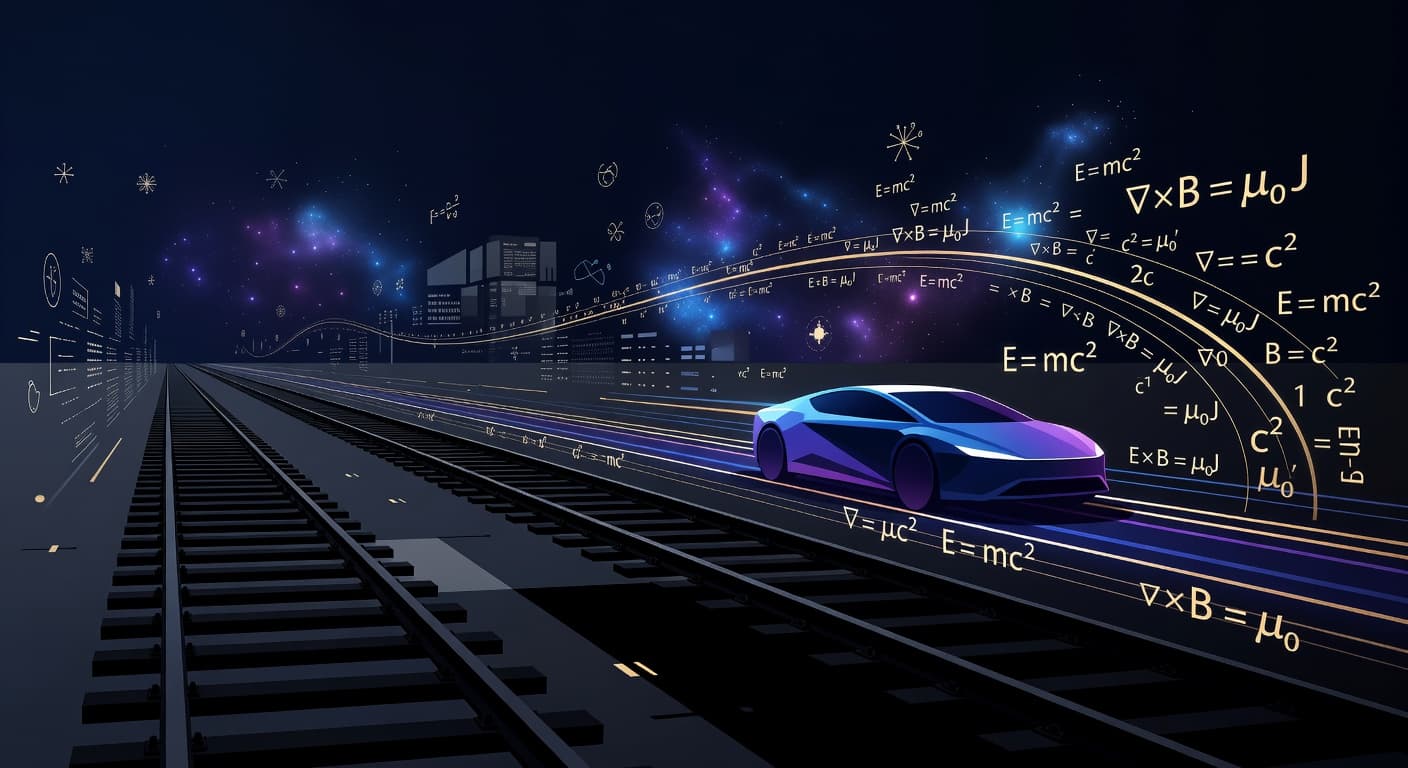
The Railroad Built Modern Physics
Let's give credit where it's due.
The institutional track/railway system —> PhD, postdoc, tenure, grants, journals, citations — is one of humanity's greatest inventions. It's a railroad, and it moves extraordinary freight. It produced the Standard Model. It found the Higgs boson. It detected gravitational waves from a billion light-years away. It mapped the cosmic microwave background to one part in a hundred thousand.
These are freight-train achievements. They required thousands of people, billions of dollars, and decades of coordinated infrastructure. No lone driver on a dirt road was going to build CERN or LIGO. The railroad earned its reputation.
However railroads have a known limitation : they only go where the tracks already exist. And the tracks are laid by consensus about what's worth investigating.
The Strongest Man in the Room
The Standard Model is not a weak theory. It may be the strongest specialized theory ever built. But the strongest athlete in the room is not automatically the most complete. A champion strongman can lift impossible weight, throw a boulder farther than anyone alive, and dominate contests built for raw power. But ask him to swim, run a marathon, or play soccer, and you see the boundary between greatness and completeness. Specialization is not totality.
Ask the Standard Model a few simple questions and watch the silence:
What is consciousness? No answer.
What is life? Not its department.
What is love? Not even a category.
What is tendency — why do systems evolve toward certain states rather than others? Outside its scope.
What is dark matter? It accounts for 27% of the universe. The Standard Model has nothing.
Where is the graviton? The force carrier for gravity — the most obvious force in daily experience — doesn't exist in the model.
Why these particular constants? The Standard Model has roughly 19 free parameters. It can tell you their values to extraordinary precision. It cannot tell you why those values and not others. It doesn't even try.
The Standard Model can give you measurement. Sometimes mechanism. But not why. And "why" is the whole point. It can tell you the score, the stats, and who won — but that's a box score, not commentary. We don't stay up late for the stat sheet. We stay up for the analyst who can tell us why they won. A theory that gives you every number but no explanation is an extraordinary scorecard for a game it hasn't actually watched.
The Railroad's Structural Problem
The institutional system is organized by department. Physics department. Mathematics department. Biology department. Computer science department. Each has its own journals, conferences, review boards, funding committees, and language.
But the actual unsolved problems — quantum gravity, the nature of consciousness, the origin of life, the measurement problem, dark matter, dark energy — sit at the intersections where no single department has jurisdiction.
A postdoc in condensed matter physics who notices that superconductor behavior might connect to cosmological structure has a career problem, not a research opportunity. A mathematician who sees patterns in elliptic curves that map onto quantum decoherence boundaries isn't going to get that funded by either the math or the physics grant committee. A software developer who notices the same dimensionless ratio appearing across multiple magnitudes in unrelated domains doesn't have a railway to run on at all.
The railroad can't go where there are no tracks. And no one lays tracks to destinations that haven't been approved by the committee that approves destinations.
The Automobile Arrives
This has been an amazing week.
On the same platform, with in days of each other, two beta users, and two frameworks arrived from completely different directions. Neither came from a university department. Neither had grant funding. Neither knew the other existed.
Blake Shatto submitted Mode Identity Theory — a framework built from a single topological postulate. One geometric starting point. From that, he claims to derive the cosmological constant, the Hubble parameter, the MOND acceleration scale, the fine structure constant, and twenty-four fermion masses — spanning 122 orders of magnitude. He brought ten supporting papers and a GitHub repository with the code. He pre-registered falsification criteria against the European Space Agency's Euclid satellite data, hard deadline October 2026. The platform's multi-agent AI review scored it a 4 out of 5. He shaped the philosophy before he ever computed a prediction.
John Holland (YouTube — Expanse Tension Theory, Zenodo — GETT papers) submitted The Gauge-Invariant Singlet Scalar Field — the foundation stone of his General Expanse Tension Theory, backed by forty-five papers already published on Zenodo. A Chartered Engineer from the UK, Holland isn't reinventing the Standard Model — he's extending it. One additional scalar field. One density-dependent coupling mechanism. At any fixed density, the theory reduces to conventional physics. Across density scales, it predicts deviations that the Standard Model doesn't. His framework is building its evidence roadmap through linked supporting papers — exactly the way living science is supposed to work.
Topology and quantum field theory. Geometry and particle physics. Two people who have never been in the same room, the same department, or the same country, working on the same deep problems from opposite ends of the mathematical landscape. Both following intuitions that no grant committee would have funded. Both now on the same platform, evaluated by the same standards, tracked against the same data.
On the same day I read these submissions, I read an MIT Technology Review article about OpenAI's plan to build a fully automated AI researcher — an autonomous agent that can tackle large, complex scientific problems by itself. Their chief scientist envisions a whole research lab in a data center by 2028.
These represent two completely different theories of how breakthroughs happen.
OpenAI's bet: make the engine more powerful. More compute, longer reasoning chains, deeper search within formalized problem spaces. Grind harder, faster, longer.
The open-road bet: humans are the variable. Not compute. Not architecture. Humans — with their different backgrounds, different intuitions, different obsessions, different decades of quiet work that no algorithm would have prioritized. Build the infrastructure where those minds can collide. Give them AI tools for verification and rigor. Track their predictions against reality. Let the universe be the referee.
I am not saying that AI is not going to fundamentally boost science and human understanding, but I believe that humans with AI are ready now, and it looks like AI is targeting 2028. The race is on!
My money is on the automobile. Because the cars aren't confined to the tracks. And in today's world, science has shortcuts that didn't exist five years ago — shortcuts that favor the driver, not the railroad.
Why Depth Alone Won't Solve Physics
Fundamental physics has almost never been solved by grinding harder on a known problem formulation.
Einstein didn't solve gravity by doing better Newtonian calculations with more compute. He noticed that acceleration and gravity feel the same — a cross-domain insight connecting mechanics and geometry that no amount of Newtonian optimization would ever produce.
Dirac didn't discover antimatter by searching a parameter space. He demanded that quantum mechanics be compatible with special relativity, wrote down the equation that satisfied both constraints, and the positron fell out uninvited.
Einstein himself is the ghost that haunts every physics department. His early breakthroughs are the story every institution tells about itself — proof that genius can reshape reality. But the institution couldn't reproduce the conditions that created him. A patent clerk following a geometric intuition across domains that no committee had approved. The moment he delivered general relativity, the institution absorbed the result and returned to its prevailing posture. As David Mermin famously summarized one strand of the postwar quantum attitude: "Shut up and calculate." The side road that produced the breakthrough was treated as a one-time exception, not a model.
It wasn't allowed often then. It isn't allowed often now. And yet — Tesla, Ramanujan, Faraday, Einstein himself — so many of the names that define the landscape were not institutional products. They were some of the drivers who could go where the railway was not.
Here's the other side of that coin: the open road is also where you find someone on YouTube drawing circles on a whiteboard and saying "and the math shows that..." when there is no math. No equations. No predictions. No falsification criteria. Just vibes and conviction. The road without verification isn't science. It's a scenic drive to nowhere.
That's the actual problem worth solving.
Not "how do we make the railway faster." Not "how do we let everyone drive anywhere." But: how do you build a road system with real lane markers — where the driving is free but the navigation is honest?
The pattern repeats across every major breakthrough: someone notices that two things nobody thought were related are related. That's not a depth-of-search problem. It's a cross-domain coupling problem. And cross-domain coupling is exactly what the departmental railway system suppresses almost by design.
An automated AI researcher that can run for days on a single problem formulation is a faster train. It's still on tracks. It still goes where the problem was formulated to go. It will not wake up one morning and wonder whether the cosmological coincidence problem dissolves rather than needing to be solved. It will not spend years following a geometric intuition before writing the first equation.
It will, however, be extraordinarily good at checking whether the equation is right once someone else writes it. And that matters enormously. AI as verification engine is transformative. AI as discovery engine for fundamental physics? I'm skeptical.
The Road System
What does the automobile version of scientific discovery actually look like?
It looks like a platform where Blake Shatto drives in from algebraic topology and posts a framework with a kill date. Where John Holland drives in from density-dependent scalar field theory with forty-five papers and a lifetime of engineering. Where someone else drives in next week from information theory or condensed matter or pure mathematics with something none of us have thought of.
The AI layer provides the road surface — consistent evaluation standards, rigor checks, mathematical auditing, prediction tracking. But the direction of travel is set by the drivers, not by where the tracks happen to go.
The critical infrastructure isn't the AI. It's three things:
Verification without credentials. The main legitimate argument for institutional gatekeeping was always "how do you know the outsider's math is right?" Fair question — when checking a calculation meant finding another human expert willing to spend weeks on it. But now you can run automated mathematical audits, MCMC validation sweeps, statistical tests with hundreds of thousands of evaluations. The math either holds or it doesn't. The universe doesn't check your institutional affiliation before answering.
Prediction tracking with accountability. A timestamped prediction with explicit falsification criteria is the one form of scientific evidence that doesn't require anyone's permission to be valid. Either the prediction matches the data or it doesn't. No committee votes on whether reality agreed with you.
Cross-domain collision space. A topological framework and a scalar field theory sitting on the same platform, evaluated by the same standards, tracked against the same data. Neither would exist in the other's department. Both might be wrong. But the collision between them — the places where they make overlapping but distinguishable predictions — that's where discovery lives.
The Transition
The people who built the railroad will resist this. Not out of malice — they genuinely believe the tracks are there for good reason, and they're not entirely wrong. You can't lay new track every time someone points at the horizon and says "what's over there?" Peer review catches errors. Institutional training builds foundational skills. The credential system filters noise. The railroad earned its caution.
But the railroad's fatal weakness is that it optimizes for reliability along known routes at the cost of discovery of new territory. And in a field where the known routes have been stuck for decades — string theory producing no testable predictions, the Standard Model complete but unexplained, dark matter still unidentified, quantum gravity still unresolved — the argument that we just need to build more track in the same directions is getting harder to make.
Every railroad-to-automobile transition in history follows the same pattern. First ignore. Then ridicule. Then "well, obviously we always knew independent research was valuable." Then quietly restructuring to incorporate the new model.
The Bet
I'm not betting against institutions. LIGO will keep detecting gravitational waves. CERN will keep smashing particles. Euclid will deliver its data on schedule. The freight trains will run.
I'm betting that the next fundamental insight — the one that connects quantum mechanics to gravity, that explains why these constants and not others, that tells us what dark matter actually is, that dissolves problems instead of solving them — will come from someone driving on the open road. Someone following an intuition that no grant committee would fund, across domains that no single department covers, verified by tools that didn't exist five years ago, tracked against predictions that the universe adjudicates without checking anyone's CV.
The railroad built the twentieth century of physics. The automobile will build the twenty-first.
The road is open. Drive.
Adam Murphy is the founder of theoryofeverything.ai, a platform for AI-reviewed independent theoretical physics, and impactme.ai. He builds physics models and AI tools from a converted schoolhouse in rural Washington state.